Agentic Testing: What It Is, How It Works and Where It Fits
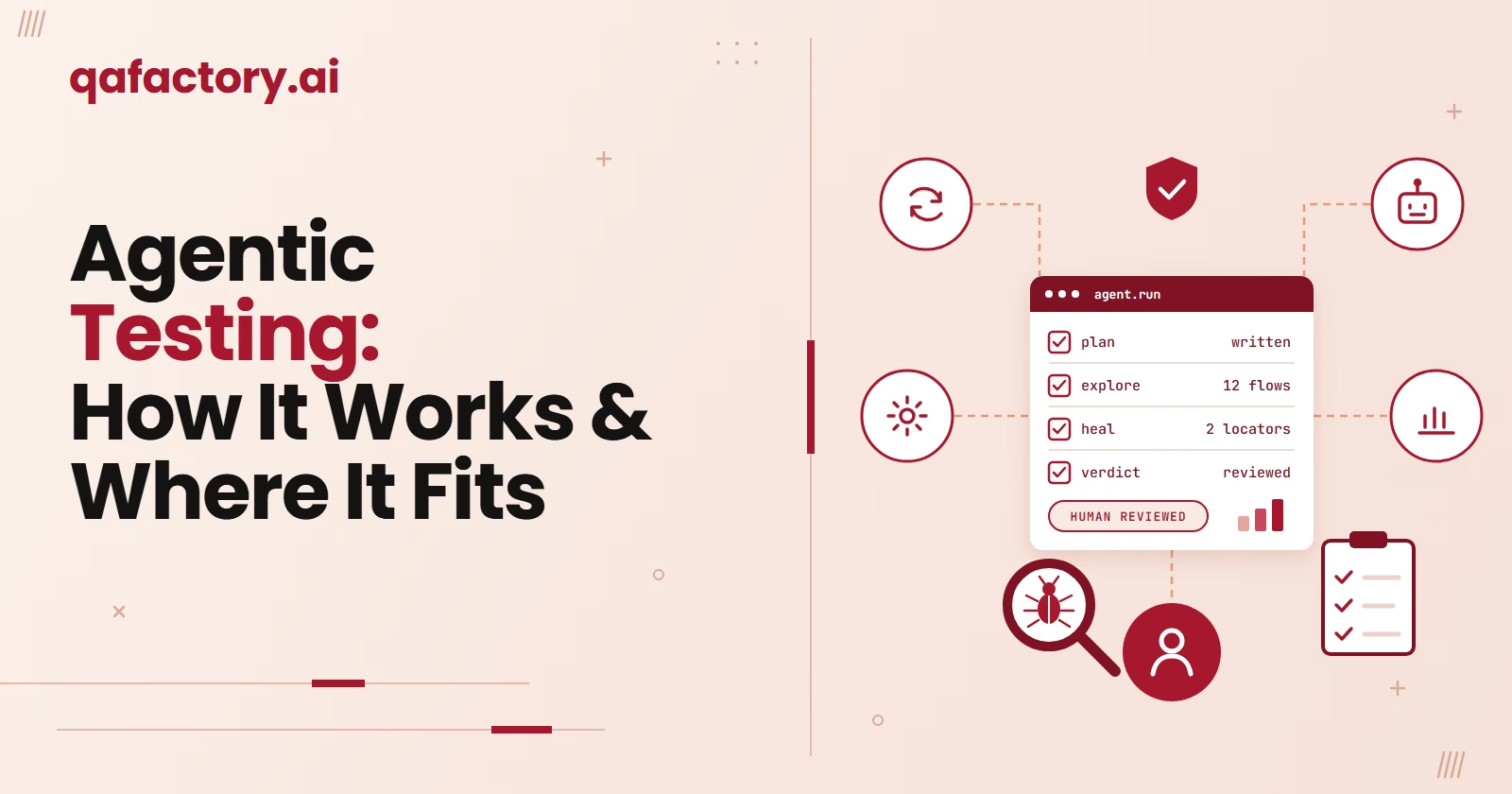
Short answer: agentic testing is software testing done by AI agents that are given a goal, such as “a new user can upgrade to the Pro plan”, and decide for themselves how to reach and check it. The agent explores the app, plans steps, runs them, reads what happens and adjusts. It complements scripted test automation rather than replacing it, and it still needs a person to judge what it finds.
Key takeaways
- Scripted tests follow steps you wrote. Agentic tests pursue a goal you stated, choosing the steps at run time.
- Agents are strongest at exploration, drafting new tests, repairing broken ones and reproducing bugs. Fixed, deterministic tests are still the best release gate.
- Playwright now documents three test agents: a planner, a generator and a healer.
- The main risks are non-deterministic results, false passes, cost and agents with too much access.
- Start with one journey, keep a human reviewing every verdict, and measure escaped bugs and engineer time, not test counts.
| Topic | Agentic testing at a glance |
|---|---|
| What is it? | Testing by AI agents that pursue a stated goal and choose their own steps |
| How does it work? | A loop: observe the app, decide the next action, act, check the result, repeat |
| Best for | Exploring new features, drafting and repairing tests, reproducing bugs |
| Not for | Being the only release gate, or anything that needs the same result every run |
| Example tooling | Playwright test agents (planner, generator, healer), agent platforms, MCP-connected agents |
| Who checks the result? | A QA engineer, who decides whether each finding is a real bug |
What is agentic testing?
Agentic testing is a way of testing software in which an AI agent works toward a goal instead of executing a fixed script. You describe the outcome to verify; the agent looks at the application, decides what to click or type, runs the step, reads the screen, logs or network responses, and chooses the next step based on what it sees.
The word “agentic” describes that autonomy: the agent has a goal, tools it may use (a browser, an API client, a terminal) and freedom to choose the order of actions. That makes it useful for work that is hard to script in advance, and less predictable than a script, which is why it needs guardrails.
How is agentic testing different from test automation?
The difference is who decides the steps. In scripted automation a person writes every step in advance. In AI-assisted testing AI helps a person write or fix those steps. In agentic testing the agent decides the steps itself while it runs.
| Scripted automation | AI-assisted testing | Agentic testing | |
|---|---|---|---|
| Who chooses the steps | An engineer, in advance | An engineer, with AI suggestions | The agent, at run time |
| Same result every run? | Yes | Yes, once the script is written | Not guaranteed |
| Handles UI changes | Breaks until someone updates it | AI proposes the fix | Adapts or repairs itself |
| Cost per run | Low | Low | Higher: model calls on every step |
| Best use | Regression gates in CI | Faster test writing and upkeep | Exploration, drafting, repair, bug reproduction |
Our guide to AI testing services covers the AI-assisted column in more detail, including how to tell testing an AI feature apart from using AI to test.
How does an agentic test work?
Most agentic testing tools run the same loop until the goal is met, a step limit is reached or the agent gives up:
- 1 Read the goal.For example: “A logged-in user can change their billing email and sees a confirmation.”
- 2 Observe the app.The agent reads the page structure, a screenshot, console logs or API responses to understand where it is.
- 3 Decide the next action.It picks one step, such as opening Settings, based on the goal and what it sees.
- 4 Act.It clicks, types or calls an API through the tools it has been given.
- 5 Check the result.It compares what happened with what the goal requires, then loops back or reports a verdict with evidence.
The quality of the verdict depends on how precisely the goal and its success criteria are written. “Billing works” invites a vague pass; “the confirmation banner shows the new email and the invoice email changes” can be checked.
What are Playwright test agents?
Playwright, the open-source browser testing framework, documents three test agents that ship with it. They are agent definitions, which Playwright describes as collections of instructions and MCP tools, used with an AI coding assistant:
- Planner: explores the application and writes a test plan in Markdown.
- Generator: turns that plan into Playwright test files, checking selectors and assertions against the live app.
- Healer: runs the suite and repairs failing tests, for example by updating locators or waits.
The useful pattern here is that the agents produce ordinary Playwright tests. The output can be reviewed, committed and run deterministically in CI, so you get the speed of an agent without making your release gate depend on one. If you already run Playwright, our guides to flaky Playwright tests and Playwright automation services cover what to check before trusting generated or healed tests.
Where does agentic testing work well?
Agents earn their cost where the steps are hard to predict in advance or where people spend time on repetitive investigation:
- Exploring new features: an agent can walk through a fresh flow and report broken states before anyone writes a test.
- Drafting tests: turning a feature or a plan into a first version of automated tests for an engineer to review.
- Repairing tests: proposing fixes when a UI change breaks locators across many tests.
- Reproducing bugs: following a vague bug report until it finds the exact steps that trigger it.
- Checking goals across variants: confirming the same outcome on different roles, plans or locales without one script per variant.
Slack’s engineering team reached a similar conclusion in Agentic Testing: Where Agents Fit in the E2E Testing Stack (June 11, 2026): deterministic end-to-end tests stay the fast regression foundation, and agents add a layer on top for exploration, flaky-workflow debugging and bug reproduction. Their summary: “Tests enforce journeys. Agents verify goals.”
Where does agentic testing fall short?
- Release gates: a gate must give the same answer for the same build. An agent may take a different path, or pass once and fail the next time.
- Judgment calls: an agent can tell you the button did nothing; it cannot tell you whether that matters to your customers this week.
- Vague goals: with loose success criteria an agent can report a pass for the wrong reason.
- Cost at scale: every step costs model calls, so running agents on every commit across hundreds of journeys adds up quickly.
What are the risks of agentic testing, and how do you control them?
The risks come from autonomy. Each one has a practical control:
| Risk | What it looks like | How to control it |
|---|---|---|
| Non-deterministic results | The same build passes on one run and fails on the next | Turn agent findings into deterministic tests before they gate a release |
| False passes | The agent reports success after checking the wrong thing | Write explicit success criteria and require evidence (screenshots, logs) with every verdict |
| Too much access | An agent with admin rights deletes data or sends real emails | Run against staging with test accounts, and give agents only the tools and permissions the test needs |
| Runaway cost | Model spend grows with every journey and every run | Set step and spend limits, and run agents on demand or nightly rather than on every commit |
| Unreviewed changes | A healer “fixes” a test by weakening its assertion | Review every generated or healed test like any other code change |
How do you start with agentic testing?
Start small and keep a person in the loop:
- 1 Pick one journey.Choose a flow that changes often and is tedious to test by hand, such as onboarding or settings.
- 2 Write the goal and success criteria.State what must be true at the end, in terms you could check yourself.
- 3 Run it on staging with limited access.Test accounts, synthetic data and only the tools the agent needs.
- 4 Review every finding.A QA engineer confirms each reported bug and each generated or healed test before it is used.
- 5 Promote what works.Turn stable findings into deterministic tests in your regression suite, and keep the agent for exploration.
At QAFactory this is how we use agents in AI-assisted testing: agents speed up exploration, drafting and repair, and a named QA engineer verifies every result before it reaches your team.
How do you measure whether agents are helping?
- Bugs found before release: real, confirmed bugs from agent exploration that scripted tests missed.
- Escaped bugs: production bugs per release, which should fall, not rise, as agents take on more work.
- Time to coverage: days from a feature landing to having reviewed tests for it.
- Maintenance hours: engineer time spent fixing broken tests each sprint.
- False-positive rate: the share of agent-reported bugs that turn out not to be bugs.
- Cost per useful finding: model spend divided by confirmed bugs and accepted tests.
See how a named QA engineer uses AI agents on your product. Start with a 48-hour QA audit from $299, or book a call.
Frequently asked questions
What is agentic testing?
It is software testing done by AI agents that are given a goal and choose their own steps to reach and verify it, observing the app, acting, checking the result and adjusting as they go.
Is agentic testing the same as AI-assisted testing?
No. In AI-assisted testing, AI helps a person write or fix test steps. In agentic testing, the agent decides the steps itself while it runs.
Will agentic testing replace test automation?
Not as a release gate. Deterministic tests remain the fast, repeatable foundation; agents add exploration, test drafting, repair and bug reproduction on top.
What are Playwright test agents?
Three agent definitions that Playwright documents: a planner that explores the app and writes a Markdown test plan, a generator that turns the plan into Playwright tests, and a healer that repairs failing tests.
Is agentic testing reliable enough for CI?
Use agents to produce tests, then run those tests deterministically in CI. Letting an agent decide pass or fail on every commit gives inconsistent results and higher cost.
What are the biggest risks?
Inconsistent results, false passes from vague goals, agents with too much access, unreviewed test changes and model costs that grow with every run.
Do we still need QA engineers?
Yes. Agents handle repetitive exploration and upkeep, but a person decides which failures are real bugs, which risks matter and whether a release is ready.
How should we start?
Pick one journey, write explicit success criteria, run the agent on staging with limited access, review every finding, and turn stable results into deterministic tests.
About this article: written by Lucia Martinez for QAFactory, which uses AI agents in its QA services and is mentioned in this guide. The Playwright and Slack Engineering references were checked against their pages on Nov 28, 2026.