The enterprise playbook for mobile app QA testing in 2026
A one-star App Store review costs more than a bug ticket. It costs CAC payback, organic ranking in App Store search, and — if it lands during a launch week — the entire growth loop you budgeted for. Mobile app QA testing is the only lever standing between your release pipeline and that outcome, and in 2026 the margin for error has effectively gone to zero.
I'm Sobuj Saha. I've spent the last five-plus years building and auditing mobile QA pipelines for cross-platform teams shipping to iOS and Android at scale, and the pattern is consistent: the average mobile defect takes 3–5x longer to hotfix than a comparable web bug, because there is no instant rollback. You wait on App Store Connect review queues. You wait on Google Play Console staged rollout halts. You wait on users to actually update the app. Meanwhile, churn compounds daily, and Apple's and Google's ranking algorithms quietly demote apps with rising crash rates and low review scores.
This playbook breaks down how engineering leads, VPs of Mobile Engineering, and SaaS founders should architect mobile app QA testing for the 2026 US market — fragmentation, compliance, performance, and the automation stack that ties it together.
The fragmentation trap: why mobile QA fails in the US ecosystem
Web QA tests against a handful of browser engines. Mobile QA tests against a combinatorial explosion of OS versions, screen densities, chipsets, and carrier conditions — and in the US market specifically, that matrix is wider than almost anywhere else on earth because of the long tail of mid-range Android devices still active alongside the newest iPhones.
The iOS vs. Android matrix
iOS fragmentation is shallow but unforgiving: Apple pushes adoption hard, so you're realistically supporting the current and prior two major versions, but any regression on a new iOS release is immediately visible to millions of users on day one. Android fragmentation is the opposite problem — deep and slow-moving. OEM skins (Samsung One UI, Pixel's stock Android, budget OEM forks) each modify permission dialogs, notification behavior, and background process limits differently, which means a test pass on a Pixel tells you almost nothing about a Galaxy A-series device.
Device farms: physical vs. virtual testing
This is where device farm integration becomes non-negotiable infrastructure rather than a nice-to-have.
- AWS Device Farm — strong for CI-integrated, scheduled regression runs across real physical devices hosted in AWS data centers; ideal when you already live in the AWS ecosystem.
- LambdaTest / BrowserStack App Automate — better real-time debugging experience and broader real-device cloud coverage for exploratory and manual QA sessions.
- Virtual devices/emulators — fast and cheap for unit-adjacent UI checks, but they cannot validate GPU rendering quirks, thermal throttling, or biometric hardware behavior.
- Physical device labs — irreplaceable for camera, NFC, Face ID/fingerprint, and real network handoff testing (Wi-Fi to 5G transitions).
The strategic answer isn't choosing one. It's a tiered model: emulators for fast feedback on every commit, cloud device farms for nightly cross-device regression, and a small physical rig for hardware-dependent edge cases that no farm reliably simulates.
Strategic dimensions of enterprise mobile app QA testing
A mature mobile app QA testing function operates across three structural layers. Skip one, and the other two can't compensate.
- 1 Continuous mobile CI/CD automationMobile builds are heavier than web builds — signing certificates, provisioning profiles, and platform-specific compile steps add friction that breaks naive CI/CD setups. Bitrise and GitHub Actions (with macOS runners for iOS) now form the backbone of automated regression, triggering Appium and XCUITest suites on every pull request rather than once per sprint. Run both: Appium for cross-platform smoke and regression suites, XCUITest for deep iOS-native validation of rendering and gesture regressions cross-platform frameworks miss.
- 2 API & core infrastructure integrityMost "UI bugs" reported by users are actually backend contract failures surfacing on the client. Run contract testing against staging APIs as a gating step before any UI automation executes — there's no point running a full Appium regression suite against a backend already returning malformed payloads. This layer also covers offline-mode resilience and graceful degradation when API latency spikes, which directly affects crash and ANR (Application Not Responding) rates downstream.
- 3 Performance under network constraintsUS 5G coverage is geographically inconsistent — dense in metro cores, patchy in suburban and rural zones — and carrier throttling under congestion is real. A strategy built only on office Wi-Fi will pass every test and still fail in the field. Simulate 3G/LTE throttling, packet loss, and high-latency 5G handoff scenarios directly inside CI using network condition profiles, validating that critical flows — login, checkout, content sync — degrade gracefully rather than timing out silently.
US market compliance & geo-specific guardrails
US consumer apps carry legal exposure that QA teams in other markets don't always plan for. These aren't optional checks — they're release-blocking gates.
- ADA mobile compliance & WCAG 2.2 AA. The ADA has been applied by US courts to digital products, and mobile apps are squarely in scope. The practical benchmark is WCAG 2.2 AA for mobile: minimum touch target sizing (24x24 CSS pixels per the 2.2 update), color contrast ratios, screen-reader label coverage for VoiceOver and TalkBack, and full functionality without gesture-only navigation. This needs its own automated accessibility test suite — not an afterthought bolted onto functional QA.
- Biometric authentication testing. Face ID and fingerprint flows fail in ways functional testers rarely simulate: enrollment changes mid-session, hardware lockout after repeated failures, and fallback-to-PIN behavior. Each needs explicit physical-device test cases, because emulators cannot reproduce the secure enclave behavior that triggers these edge cases.
- Fintech & payment infrastructure validation. Any app touching money in the US market needs dedicated validation against Apple Pay, Google Pay, and Plaid integrations — token expiration handling, declined-transaction UX, and webhook reliability under retry storms. A single untested edge case in a payment SDK update can silently break checkout for a subset of users, and you often won't see it in your crash dashboard because the transaction simply fails quietly upstream.
Quick answers: US compliance for mobile QA
Is WCAG 2.2 AA legally required for mobile apps in the US?
There's no single federal statute naming WCAG 2.2 AA for private mobile apps, but it is the de facto evidentiary standard US courts and the DOJ reference when assessing ADA digital accessibility claims, making it the standard engineering teams test against to manage legal risk.
Should payment SDK testing run in the same suite as UI regression?
No. Payment and biometric flows should run as isolated, gated suites with their own physical-device requirements, since bundling them into general UI regression hides failures and slows the overall pipeline.
Data-driven quality: KPIs for the engineering dashboard
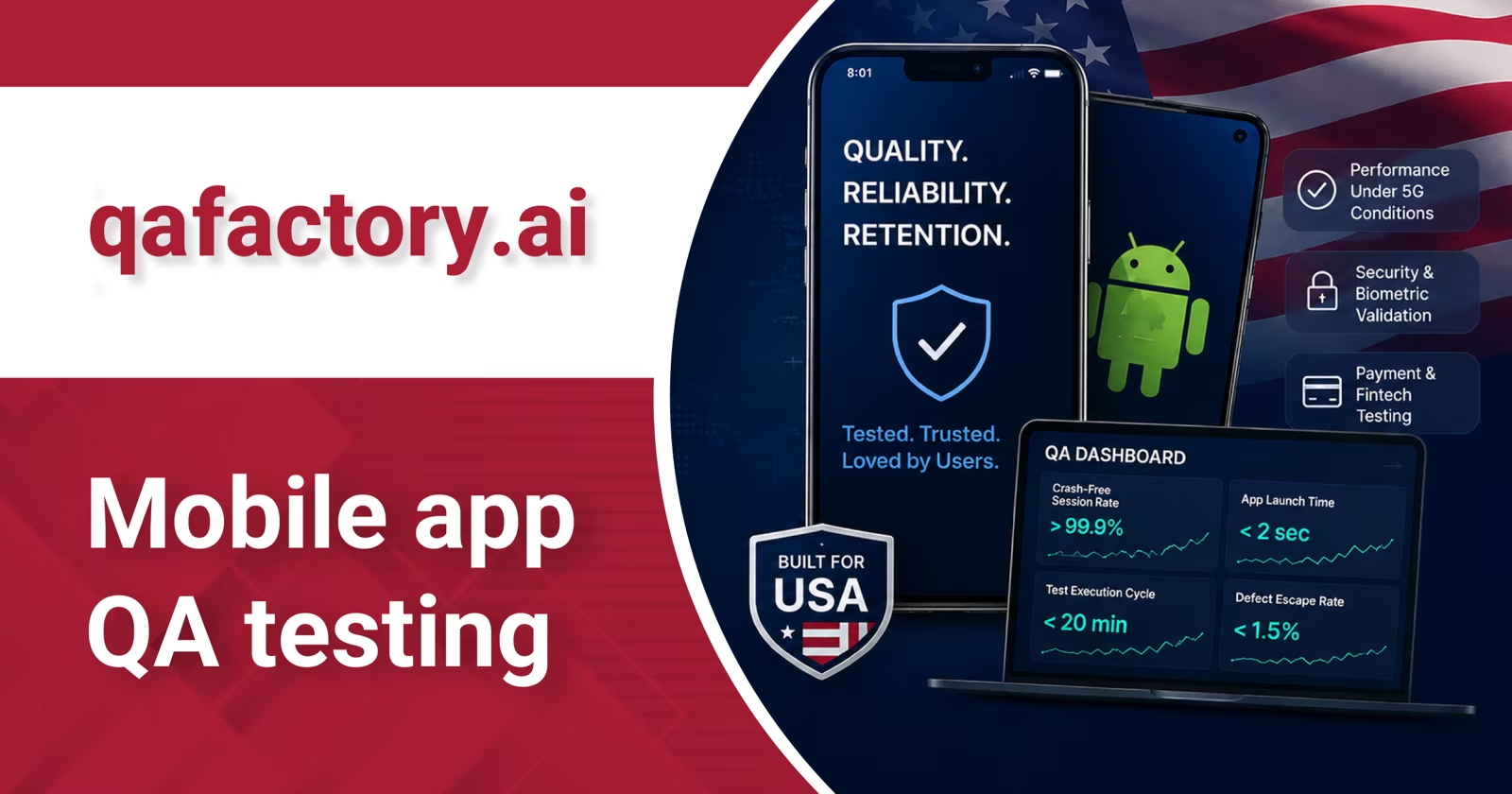
Vague QA sign-off ("looks good to me") doesn't scale past a five-person engineering team. Enterprise mobile organizations run a quality dashboard against fixed targets, reviewed at every release gate:
| KPI | Definition | Target (2026) |
|---|---|---|
| Crash-Free User Session Rate | Percentage of user sessions completed without a fatal crash or force-close event | > 99.9% |
| App Launch Time | Cold-start time from tap to fully interactive first screen | < 2 seconds |
| Test Execution Cycle | Total time for the full automated regression suite to complete in CI | < 20 minutes |
| Defect Escape Rate | Percentage of bugs found in production vs. total bugs found pre- and post-release | < 1.5% |
These four metrics matter because they're causally linked: a slow test execution cycle delays feedback, which increases defect escape rate, which drives down crash-free session rate, which directly suppresses App Store and Google Play ranking algorithms — both of which now weight stability signals heavily in store search visibility.
Streamlining your mobile automation framework with QAFactory.ai
Most mobile QA teams don't have a coverage problem — they have a velocity and flakiness problem. Test suites exist; they're just too slow to run on every PR, and too unreliable to trust when they fail. QAFactory.ai is built specifically to close that gap for cross-platform mobile pipelines.
- Accelerated Appium/Playwright test generation — analyzes existing user flows and auto-generates maintainable Appium and Playwright test scaffolds, cutting initial suite-authoring time without sacrificing the readability your team needs for long-term maintenance.
- AI-driven flakiness analytics — instead of re-running flaky tests until they pass (a habit that erodes trust in the entire suite), the analytics layer fingerprints failure patterns across device farm integration runs to separate genuine regressions from environment noise.
- Audit-ready compliance logging — every automated run against ADA/WCAG 2.2 AA checks, biometric flows, and payment validations is captured into a structured, exportable log, so compliance documentation is a byproduct of testing rather than a separate scramble before an audit.
- CI/CD-native integration — drops directly into Bitrise and GitHub Actions pipelines, keeping the test execution cycle inside the sub-20-minute target enterprise teams need for fast PR feedback.
The net effect: engineering leads spend less time triaging false-positive failures and more time shipping, while VPs of Mobile Engineering get a defensible, data-backed quality record for every release.
Conclusion: build for retention, not just downloads
Downloads are a vanity metric if the app churns users in week one over a crash that proper mobile app QA testing would have caught in CI. The teams winning App Store and Google Play rankings in 2026 aren't necessarily shipping more features — they're shipping fewer regressions, faster, with compliance built into the pipeline rather than retrofitted before a legal review.
If you're an engineering lead, PM, or founder staring at a rising defect escape rate or a flaky CI suite that nobody trusts anymore, that's a pipeline architecture problem — and it's fixable.
Talk directly with the QAFactory.ai engineering team about your current crash-free rate, test execution cycle, and compliance gaps — and leave with a concrete next step, not a sales pitch.
About the author: Sobuj Saha is a Mobile QA Architect & Engineering Consultant at QAFactory.ai. He has spent 5+ years designing and auditing cross-platform mobile QA pipelines for SaaS and consumer apps, with a focus on CI/CD automation, device farm strategy, and US compliance readiness (ADA/WCAG 2.2, fintech payment validation). He advises engineering leads and VPs of Mobile Engineering on reducing defect escape rate and test flakiness at scale.