QA audit services: the complete software quality assessment guide for SaaS teams (2026)
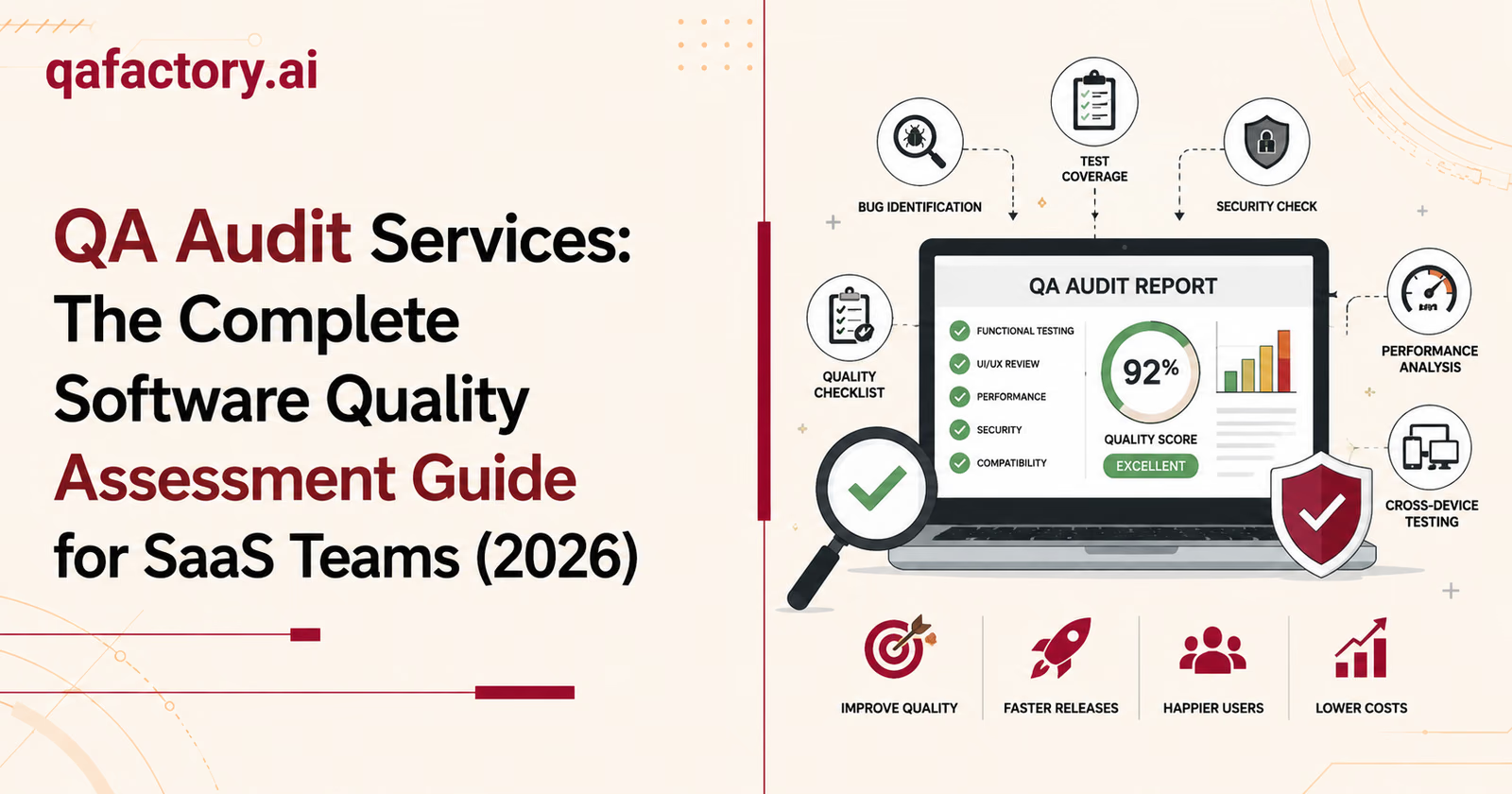
A QA audit is a structured, independent evaluation of a software team’s testing process, tooling, coverage, and release practices — designed to identify quality risks before they reach production and give leadership a prioritized plan to fix them.
Most SaaS teams don’t find out their QA process is broken from a dashboard. They find out from a customer, on a Monday morning, after a weekend release quietly corrupted billing data or locked paying accounts out of the product. By the time engineering leadership is looped in, the bug has already been screenshotted, shared internally, and possibly posted somewhere public.
That is the hidden cost of a weak QA process: it doesn’t show up as a line item until it’s an incident. Escaped defects, missed regressions, and untested edge cases rarely appear on a roadmap review — they appear in churn numbers, support ticket volume, and the growing reluctance of engineering leaders to ship on Fridays.
A QA audit is how mature SaaS organizations catch this before it becomes expensive. Instead of guessing whether the current testing process is “good enough,” an audit gives you an evidence-based answer: what’s covered, what isn’t, where the risk actually sits, and what to fix first.
This guide covers what QA audit services are, why they matter for SaaS companies specifically, the warning signs that indicate you need one, what a proper audit includes, how to run one internally versus bringing in outside help, and how QAFactory approaches the process.
What are QA audit services?
Definition — QA audit (software quality audit): an assessment of an organization’s quality assurance process, including test strategy, test coverage, automation, defect management, and release readiness, measured against established software testing practices such as those documented by ISTQB and ISO/IEC/IEEE 29119, to identify gaps and quantify release risk.
Unlike a one-off bug hunt or a penetration test, a QA audit looks at the system that produces quality — or fails to. It examines how test cases are written, how regression is managed as the product grows, how automation is maintained, how bugs are triaged and reported, and whether the team has visibility into quality trends over time.
- A QA audit evaluates process, coverage, tooling, and documentation — not just current bugs.
- It produces a risk-ranked list of gaps, not just a pass/fail grade.
- Audits can be performed internally by an engineering or QA lead, or externally by a specialized QA firm.
- The output should be actionable: a checklist, a roadmap, and clear ownership of next steps.
- Audits are most valuable before a high-stakes event — a fundraising round, an enterprise sales cycle, a major migration, or a platform launch.
QAFactory offers a 48-hour QA audit, scoped specifically for teams that need a fast, evidence-based read on release risk rather than a multi-week consulting engagement.
Why every SaaS company needs regular QA audits
SaaS products change constantly — new features, new integrations, new edge cases — but QA processes rarely get re-evaluated at the same pace. Regular audits keep testing coverage aligned with how the product has actually grown, not how it looked a year ago.
Most SaaS QA processes are built early, when the product is small and a founding engineer can hold the entire system in their head. That process rarely scales cleanly. Features get added faster than test coverage does. Automation scripts get written once and never revisited. Nobody owns the regression suite. Within 18 to 24 months, the gap between “what we think is tested” and “what is actually tested” can be significant — and it’s invisible until something breaks.
If your team can’t answer “what percentage of our critical user flows have regression coverage?” with a specific number, that’s already a signal an audit is overdue. Vague confidence — “I think we’re pretty well covered” — is usually a sign that nobody has measured it.
A QA audit matters at several recurring points in a SaaS company’s lifecycle:
- After rapid feature growth. Fast shipping without proportional test investment is the most common source of quality debt.
- Before a fundraising round or acquisition due diligence. Investors and acquirers increasingly ask about engineering and quality practices, not just growth metrics.
- Before entering enterprise sales. Enterprise buyers ask about testing, security, and release processes during procurement and security review.
- After a major incident. A root-cause review after a Sev-1 outage should include an honest look at why the process didn’t catch it.
- When scaling the engineering team. Doubling headcount without a matching QA strategy usually multiplies inconsistency, not quality.
- Before migrating infrastructure or replatforming. Migrations are one of the highest-risk activities a SaaS team undertakes, and existing tests may not even map to the new environment.
10 warning signs your QA process needs an audit
Use this list as a fast self-assessment. If more than three of these apply to your team, a QA audit is worth prioritizing.
- Recurring production bugs — the same category of defect, such as permissions or billing edge cases, keeps reappearing across releases.
- Poor regression coverage — core workflows aren’t consistently re-tested before each release.
- No release checklist — releases go out based on individual judgment rather than a documented go/no-go process.
- No documented test strategy — nobody can explain, in writing, what gets tested, how, and why.
- High escaped-defect rate — more bugs are found by customers than by QA before release.
- Slow, unpredictable release cycles — testing becomes a bottleneck because nobody trusts the suite enough to ship quickly.
- Weak or outdated documentation — test cases, environments, and known issues live in someone’s head instead of a shared system.
- No automation roadmap — automation exists, or doesn’t, without a clear plan for what to automate next and why.
- Limited or absent QA metrics — no visibility into defect density, escape rate, coverage, or flaky test rates.
- Poor developer–QA collaboration — QA is treated as a gate at the end of the process instead of a partner throughout it.
Don’t mistake “we haven’t had a major outage recently” for “our QA process is healthy” — absence of a recent incident is often evidence of luck, not low risk. And don’t treat automation coverage percentage alone as a quality signal: automated tests that check the wrong things, or that the team has learned to ignore because they’re flaky, can be worse than no automation at all.
What does a QA audit include?
A complete QA audit reviews ten core areas: process, test strategy, automation, coverage, bug reporting quality, release readiness, risk assessment, documentation, metrics, and CI/CD integration. A narrow audit that only checks “how many tests do you have” misses most of the risk.
- QA process review — how work moves from requirement to tested, shippable code. Who owns testing at each stage, when QA gets involved, and whether the process is documented or exists only as tribal knowledge.
- Test strategy review — whether there’s a deliberate strategy: which layers get automated versus tested manually, how risk is prioritized, and how the strategy maps to the product’s actual architecture.
- Automation assessment — the health of existing automated tests, not just their count. Flakiness rate, maintenance burden, frameworks used (commonly Playwright or Cypress for web applications), and whether automation actually runs in CI or has quietly stopped being trusted.
- Test coverage analysis — mapping which user flows, features, browsers, devices, and edge cases are actually covered versus assumed to be covered. This is usually where the biggest surprises show up.
- Bug reporting quality — whether defects are documented well enough for an engineer to reproduce and fix them without follow-up questions: clear steps, environment details, expected versus actual behavior, and supporting evidence.
- Release readiness — whether there’s a repeatable, documented process for deciding a build is safe to ship — a checklist, sign-off criteria, and a rollback plan.
- Risk assessment — which parts of the product carry the highest business risk if they break (billing, authentication, data integrity) and whether testing effort is actually weighted toward those areas.
- Documentation review — the state of test cases, known issues, environment setup guides, and onboarding materials for new QA or engineering hires.
- Metrics review — whether the team tracks meaningful quality metrics — escaped defect rate, defect density, coverage trends, mean time to detect and resolve — and whether those metrics inform decisions.
- CI/CD validation — whether automated tests are properly wired into the pipeline (checks on pull requests, deploy gates, scheduled regression runs) rather than existing as scripts someone runs manually when they remember to.
The 14-point QA audit checklist
| # | Audit item | What “good” looks like |
|---|---|---|
| 1 | Documented test strategy | Written, current, and understood by both QA and engineering |
| 2 | Critical flow coverage | Core revenue and trust-impacting flows have defined test cases |
| 3 | Regression suite | Runs consistently before every release, not ad hoc |
| 4 | Automation framework | Actively maintained; low flakiness; runs in CI |
| 5 | Bug report standards | Consistent template with repro steps and evidence |
| 6 | Release checklist | Written sign-off criteria, not verbal agreement |
| 7 | Risk-based prioritization | High-risk areas get proportionally more test effort |
| 8 | Cross-browser and device coverage | Defined support matrix, tested against it |
| 9 | API and integration testing | Contract and integration points explicitly tested |
| 10 | Quality metrics tracked | Escape rate, defect density, and coverage trends visible |
| 11 | CI/CD test integration | Automated checks gate merges and deploys |
| 12 | Documentation currency | Test cases and environment docs updated within the last quarter |
| 13 | Ownership clarity | A named owner for QA process and coverage decisions |
| 14 | Post-incident review | Defects tied to root cause and fed back into test coverage |
Internal QA audit vs external QA audit
| Factor | Internal QA audit | External QA audit |
|---|---|---|
| Objectivity | Limited — internal teams may unconsciously protect their own process | High — no incentive to soften findings |
| Benchmark knowledge | Based on internal experience only | Informed by patterns seen across multiple SaaS products |
| Speed | Often delayed by competing engineering priorities | Dedicated focus; typically faster turnaround |
| Cost | “Free” in dollars, but consumes engineering time | Direct cost, but no opportunity cost on the team |
| Depth of tooling review | Depends on internal familiarity with the QA tooling landscape | Typically broader exposure to automation frameworks and practices |
| Best used for | Ongoing internal health checks between major audits | Pre-fundraise, pre-launch, post-incident, or first-time baseline assessments |
An internal audit costs nothing directly, the reviewer already knows the product context, and it’s easy to schedule informally and repeat often. The trade-off is that it’s hard to be objective about a process you built and maintain, and it competes with day-to-day engineering priorities — so it often gets deprioritized.
An external audit brings an independent view with no internal politics, plus pattern recognition from testing across other SaaS products. It requires onboarding an outside team to your product context and carries a direct cost, though typically far lower than the cost of a missed production incident.
If your team has never had an outside review of its QA process, or you’re heading into a high-stakes event such as fundraising, an enterprise deal, or a major release, start with an external audit for an unbiased baseline. Use internal reviews to maintain that baseline between external checkpoints.
Common QA process gaps found during audits
These are the gaps that show up repeatedly across SaaS teams, regardless of size:
- No single owner for quality. When “everyone” owns QA, in practice no one does. Bugs get triaged inconsistently and coverage decisions are made ad hoc.
- Automation that nobody trusts. Flaky tests train engineers to ignore failures. Once a team starts re-running a failing suite “just to see if it passes this time,” the automation has stopped providing signal.
- Testing concentrated at the end of the cycle. QA gets involved only after development is “done,” turning testing into a bottleneck instead of a continuous check — contrary to shift-left principles.
- Undocumented tribal knowledge. One senior QA engineer or founding developer knows which areas are fragile and need manual testing before every release. If they leave, that knowledge leaves with them.
- No risk-based prioritization. Equal test effort is spread across low-risk and high-risk areas instead of weighting toward what actually damages the business if it breaks.
- Bug reports that require follow-up. Vague reports — “checkout is broken” — without reproduction steps or environment details slow down fixes and erode trust between QA and engineering.
- No regression safety net during refactors. Teams avoid necessary refactoring because they’re not confident a break in existing functionality would be caught.
The VERIFY audit framework
To keep audits consistent and repeatable, QAFactory structures every audit engagement around six stages that move from understanding the current state to a prioritized action plan.
- 1 V — Validate current QA processDocument how testing actually happens today, versus how it’s assumed to happen.
- 2 E — Examine risk and coverage gapsMap critical user flows against actual test coverage to find the highest-risk blind spots.
- 3 R — Review automation and toolingAssess automation health, framework choice, flakiness, and CI/CD integration.
- 4 I — Inspect bug and defect dataAnalyze historical defects for patterns, escape rate, and reporting quality.
- 5 F — Formalize documentation standardsEvaluate test case, environment, and release documentation for completeness and currency.
- 6 Y — Yield a release-readiness roadmapDeliver a prioritized, actionable plan ranked by business risk.
This structure ensures an audit produces more than a list of observations — it produces a roadmap the team can actually execute against, with the highest-risk items surfaced first.
Benefits of outsourcing QA audits
Outsourcing a QA audit brings an objective, pattern-informed perspective without pulling engineering time away from the roadmap — and typically delivers findings faster than an internal review squeezed between sprints.
- Objectivity. An outside reviewer has no reason to soften findings about a process they didn’t build.
- Speed. A dedicated audit team can move faster than an internal team juggling the audit alongside regular sprint work.
- Cross-product pattern recognition. External QA specialists have seen how similar gaps play out across other SaaS products, which helps prioritize what actually matters versus what’s theoretical.
- No opportunity cost on engineering. The audit happens in parallel with the roadmap instead of pulling developers off feature work.
- A credible artifact for stakeholders. An independent audit report carries more weight with investors, enterprise buyers, or leadership than a self-assessment.
How QAFactory performs a QA audit
QAFactory’s audit combines manual exploratory testing of critical flows with a review of existing test coverage, automation, and release process — delivered as prioritized, evidence-backed findings within 48 hours.
- Manual QA of the critical flows most likely to affect revenue and customer trust — signup, billing, permissions, and core workflows.
- Automation review, including how existing suites built with frameworks like Playwright or Cypress are structured and maintained.
- Detailed bug reports with severity, reproduction steps, environment details, screenshots, and video — so engineering can act without a back-and-forth.
- A release-risk summary that translates findings into a clear picture of where the biggest exposure sits.
- Flexible engagement, scoped to a single audit or extended into ongoing managed QA coverage if the findings warrant it.
- Fast onboarding — the audit is designed to start producing findings within 48 hours rather than requiring weeks of ramp-up.
The audit is delivered through the QAFactory.ai workspace, so findings, evidence, and recommendations stay visible to the team rather than living in a static PDF that goes stale after the first sprint.
QA maturity levels
| Level | Characteristics |
|---|---|
| Level 1 — Ad hoc | No documented process; testing depends on individual judgment; bugs found mostly by customers |
| Level 2 — Repeatable | Basic checklist exists; some regression testing before releases; still largely manual and inconsistent |
| Level 3 — Defined | Documented test strategy; consistent bug reporting standards; automation exists for key flows |
| Level 4 — Managed | Metrics tracked and reviewed regularly; automation integrated into CI/CD; risk-based prioritization in place |
| Level 5 — Optimized | Continuous improvement loop; quality data feeds directly into planning; QA is a partner throughout the development cycle, not a gate at the end |
Most SaaS companies audited for the first time sit at Level 1 or 2. Moving even one level up materially reduces escaped defects and release anxiety.
Common QA risks
| Risk area | Why it matters |
|---|---|
| Billing and payments | Direct revenue impact; errors damage trust immediately |
| Authentication and permissions | Security and data-privacy exposure if broken |
| Data integrity | Corrupted or lost data is often unrecoverable and erodes customer confidence |
| Third-party integrations | Breakage often goes unnoticed until a partner or customer reports it |
| Mobile and cross-browser behavior | Inconsistent experiences fragment quality across your user base |
| Upgrade and migration paths | High-change, low-frequency events with limited historical test coverage |
QA metrics worth tracking
| Metric | What it tells you |
|---|---|
| Escaped defect rate | Bugs found by customers versus caught internally before release |
| Defect density | Number of defects relative to codebase size or feature area |
| Test coverage by critical flow | Whether the flows that matter most are actually protected — not just a headline percentage |
| Automation flakiness rate | Whether the team can trust automated test results |
| Mean time to detect | How quickly issues surface after being introduced |
| Mean time to resolve | How quickly confirmed defects get fixed once identified |
| Release rollback rate | How often a release has to be reverted due to quality issues |
Audit deliverables and timeline
| Deliverable | Description |
|---|---|
| Findings report | Prioritized list of gaps, ranked by business risk |
| Bug reports | Reproducible defects found during testing, with evidence |
| Coverage map | What’s tested today versus what’s assumed to be tested |
| Release-readiness recommendation | Clear read on current release risk |
| Next-step roadmap | Prioritized actions, sequenced by impact and effort |
| Phase | Typical timing |
|---|---|
| Kickoff and access setup | Day 1 |
| Exploratory and process review | Days 1–2 |
| Findings compiled and prioritized | By 48 hours |
| Roadmap and recommendation delivered | Immediately following findings |
Frequently asked questions
What is a QA audit in software development?
A QA audit is a structured review of a software team’s testing process, automation, coverage, and release practices. It identifies gaps between what’s assumed to be tested and what’s actually verified, then produces a prioritized plan to close the highest-risk gaps first.
How long does a QA audit take?
It depends on scope and provider. Internal audits can take weeks when squeezed between other priorities. Dedicated external audits, like QAFactory’s 48-hour QA audit, are scoped specifically to deliver findings within two business days.
How much does a QA audit cost?
Cost varies by scope and provider. QAFactory’s 48-hour QA audit starts from $299 for a one-time, evidence-based assessment of critical flows and release risk. Broader, ongoing engagements are priced separately based on scope.
What’s the difference between a QA audit and regression testing?
A QA audit evaluates the entire testing process — strategy, automation, documentation, and metrics. Regression testing is one specific activity, re-testing existing functionality after changes, that a QA audit will review as part of the broader assessment.
Do small SaaS startups need QA audits?
Yes, particularly before a fundraising round, an enterprise sales cycle, or a major release. Early-stage teams often have the least formal QA process, which makes an audit’s findings especially high-leverage at that stage.
What’s the difference between manual and automated testing in an audit?
An audit typically reviews both: manual exploratory testing to find issues automation might miss, and a review of existing automated coverage, often built with Playwright or Cypress, to assess its health and maintenance burden.
Can a QA audit be done without pausing development?
Yes. A QA audit runs in parallel with ongoing development, typically against a staging environment, and doesn’t require the team to stop shipping features during the assessment.
What happens after a QA audit is complete?
You receive a prioritized findings report, documented bugs with evidence, and a roadmap. From there, teams either address the findings internally or extend into ongoing managed QA support if deeper coverage gaps were identified.
How often should a SaaS company run a QA audit?
There’s no universal cadence, but many teams benefit from a full audit annually, plus a lighter review after major product changes, team scaling events, or significant incidents.
What’s included in a QA audit checklist?
A thorough checklist covers test strategy documentation, critical-flow coverage, regression consistency, automation health, bug reporting standards, release sign-off criteria, risk-based prioritization, and quality metrics tracking.
Is a QA audit the same as a code audit?
No. A code audit reviews source code quality, architecture, and technical debt. A QA audit reviews the testing process and quality assurance practices around that code — though findings from each can inform the other.
Who should be involved in a QA audit?
Typically engineering leadership, the QA or testing lead if one exists, and product management, since release risk and prioritization decisions touch all three functions.
Can QA audits help before a fundraising round?
Yes. Investors and acquirers increasingly review engineering and quality practices during due diligence. An independent audit report is a credible artifact that demonstrates operational maturity.
What tools are typically reviewed during a QA audit?
Test management tools, automation frameworks (commonly Playwright or Cypress for web applications), bug tracking systems like Jira or Linear, and CI/CD pipelines are all typically in scope.
Does QAFactory only work with SaaS companies?
QAFactory’s QA services are built for teams shipping continuously, including SaaS, AI products, and mobile apps. Mobile app QA and AI app QA services cover work outside traditional web SaaS.
Ready to see where your QA process actually stands?
Guessing about release risk gets expensive. A structured QA audit replaces that guesswork with a prioritized, evidence-backed picture of what’s working, what isn’t, and what to fix first — starting with the flows that matter most to your customers and your revenue.
Request a free QA audit and get an evidence-based read on your release risk, with findings and a prioritized roadmap delivered within two business days.
About this article: this guide was prepared by the QAFactory team as a practical reference for founders, CTOs, and engineering leaders evaluating QA audit services. It reflects current industry practice as of 2026.