QA outsourcing services for SaaS companies
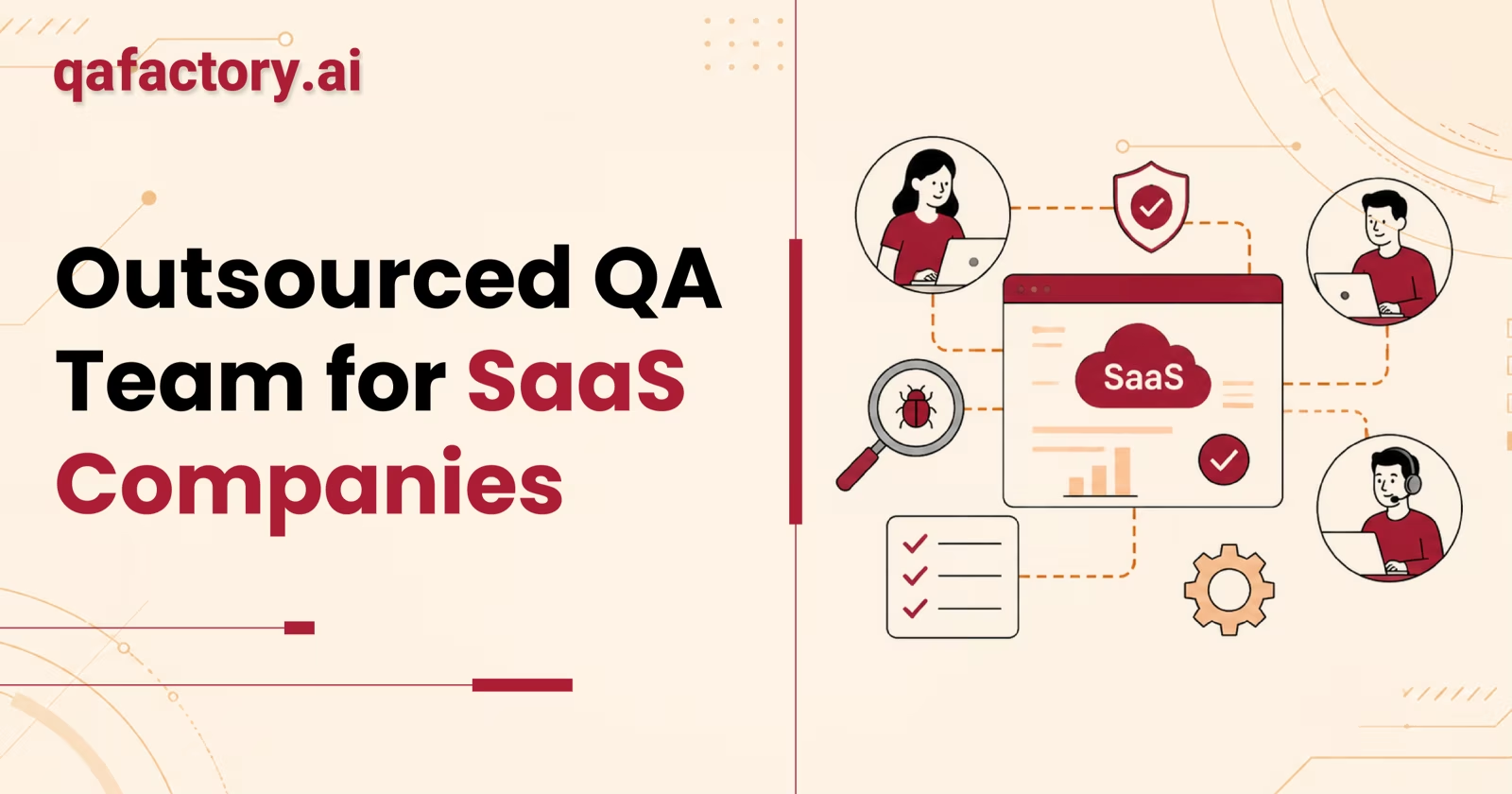
QA outsourcing services give SaaS companies access to experienced testing teams without the cost and delay of building an in-house QA department. This guide explains what QA outsourcing includes, when to bring in a partner, how in-house and outsourced QA compare, and how QAFactory's 7-step framework helps engineering teams ship reliable software faster.
Introduction
Every SaaS company eventually runs into the same tension: engineering wants to ship faster, and the business wants fewer bugs in production. Quality assurance sits directly in the middle of that trade-off, and as a product and its codebase mature, the testing workload usually outgrows what a small internal team can reasonably cover.
Many engineering leaders address this by outsourcing quality assurance to a dedicated external team. Done well, QA outsourcing services extend a company's testing capacity, reduce the number of defects that reach production, and free engineers to focus on building features instead of writing and executing every test case themselves. Done poorly, outsourcing can introduce communication gaps, inconsistent test coverage, and a partner who doesn't understand the product well enough to test it meaningfully.
If you're evaluating outsourced QA testing services for the first time, the goal isn't to hand off responsibility for quality altogether. It's to add structured, repeatable testing capacity so your engineering team can keep shipping without quality becoming the bottleneck.
What are QA outsourcing services?
QA outsourcing services are the practice of hiring an external, specialized team to plan, execute, and report on software testing activities, instead of — or in addition to — building that capability entirely in-house.
In practice, this covers a broad set of activities: writing test plans and test cases, executing manual functional testing, running regression testing services before releases, building and maintaining test automation, and validating that a release is safe to ship. Some providers, including QAFactory, also cover performance and security sanity checks as part of a broader QA program.
QA outsourcing generally takes one of three shapes:
- Project-based testing — a defined engagement scoped around a specific release, migration, or product launch.
- Dedicated QA team — an outsourced QA team embedded with your engineering team on an ongoing basis, joining standups and sprint planning like an internal hire would.
- Managed QA program — the outsourcing partner owns the end-to-end testing process, including strategy, execution, and reporting, against agreed quality goals.
The right shape depends on how mature your release process already is and how much ownership you want to keep in-house. Most SaaS companies start with project-based testing and move toward a dedicated QA team as release frequency increases.
It's worth distinguishing QA outsourcing from simply hiring a freelance tester. A single contractor can execute test cases, but outsourcing implies a team with defined processes — test strategy, documented test cases, structured bug reporting, and a strategy for regression coverage over time. That process layer is usually what determines whether outsourced QA testing services actually reduce production bugs or simply move the same ad hoc testing to a different group of people.
When should SaaS companies outsource QA?
There's no single trigger that means it's time to outsource QA testing services, but a few patterns show up consistently across SaaS teams:
- You're releasing more frequently than your current QA capacity can reasonably cover.
- Bugs are reaching production because there's no dedicated QA function yet, only engineers testing their own code.
- You're entering an enterprise or regulated segment that expects documented, repeatable testing processes.
- Your engineering headcount is scaling faster than your QA headcount, widening the coverage gap sprint over sprint.
- You need consistent regression testing before major releases, but no one owns it end-to-end.
- Senior engineers are spending meaningful time on manual testing instead of building product.
- You want to introduce test automation but don't have the in-house expertise to build and maintain a reliable suite.
None of these signals on their own means you need to outsource immediately. But when two or three show up at once, it's usually a sign that testing capacity, not engineering capacity, is the bottleneck standing between your team and a faster release cadence.
Not sure whether outsourcing makes sense yet? Request a free 48-hour QA audit and get an outside view of where your current testing process has gaps.
Benefits of QA outsourcing services
The case for outsourcing QA usually comes down to a combination of speed, cost, and access to skills that are hard to hire for individually. The most consistent benefits SaaS teams report are:
- Faster release cycles — a dedicated testing team can run functional and regression testing in parallel with development instead of queuing behind it.
- More predictable QA costs — outsourced QA testing services are typically structured around a scope or a team size, which is easier to plan against than the fully-loaded cost of in-house hires.
- Access to specialized skills — automation engineering, performance testing, and security-aware testing are easier to access through a QA partner than to hire for one role at a time.
- Scalability — an outsourced QA team can flex up before a major release and flex down afterward, without a hiring or layoff cycle.
- A fresh set of eyes — testers who didn't write the code are more likely to catch assumptions and edge cases the original developer missed.
- Structured documentation — a good QA partner produces test plans, bug reports, and release recommendations your team can reuse, audit, and hand off later.
Taken together, these benefits explain why QA outsourcing has become a standard part of how growing SaaS companies scale engineering — not as a replacement for internal ownership of quality, but as a way to keep testing capacity in step with how fast the product is changing.
In-house QA vs QA outsourcing
Neither model is universally better — the right choice depends on your release cadence, budget, and how much long-term ownership you want to keep internal. The comparison below outlines where each option typically has the advantage.
| Factor | In-house QA | QA outsourcing |
|---|---|---|
| Time to build capacity | Weeks to months (hiring, onboarding) | Days to weeks |
| Cost structure | Fixed salaries, benefits, tooling overhead | Scoped engagement or team-based pricing |
| Scalability | Requires new hires to scale up or down | Flexes with release volume |
| Access to specialized skills | Depends on who you can hire | Automation, regression, and release testing available on demand |
| Institutional product knowledge | Builds up naturally over time | Requires deliberate onboarding and documentation |
| Best fit for | Teams with steady, predictable QA needs | Teams scaling fast or lacking dedicated QA today |
Many SaaS companies land on a hybrid model: a small internal QA lead who owns product knowledge and priorities, supported by an outsourced QA team that handles execution, regression coverage, and automation. This keeps institutional knowledge close to the product while still giving the team room to scale testing volume up or down as release schedules shift.
Common mistakes companies make when outsourcing QA
Outsourcing QA testing services fails most often for process reasons, not because the outside testers weren't capable. The most common mistakes are avoidable:
- Choosing a vendor on price alone, without reviewing how they actually structure test strategy and reporting.
- Skipping a documented onboarding process, so the outsourced team starts testing without understanding the product's critical workflows.
- Treating the QA partner as pure headcount instead of building a regular communication cadence with them.
- Never establishing a maintained regression suite, so the same bugs resurface release after release.
- Expecting full test automation from day one, before there's a stable manual test baseline to automate against.
- Not defining what a finished release looks like, which makes it hard to hold any QA team — in-house or outsourced — accountable.
Most of these mistakes come down to treating outsourcing as a transaction instead of a working relationship. The engagements that succeed tend to have clear ownership on both sides, a shared definition of quality, and a process that improves release over release rather than resetting each time.
QAFactory's 7-step QA outsourcing framework
Consistent quality doesn't come from testing harder — it comes from testing with a repeatable process. QAFactory structures every outsourced QA engagement around seven steps, whether the project is a single release or an ongoing dedicated QA team.
- 1 Discovery & risk assessmentEvery engagement starts by understanding the product, not just the codebase. This step maps critical user workflows, existing known issues, past incident history, and the areas of the application where a defect would cause the most damage — so testing effort is weighted toward risk, not spread evenly across everything. It also establishes how the team currently ships releases, so the QA process fits into the existing workflow instead of working against it.
- 2 Test strategy planningBased on the discovery findings, QAFactory defines what will be tested, how, and how often — covering functional coverage, regression scope, browser and device matrices, and where automation fits. This becomes the reference document both teams work from for the rest of the engagement, and it is revisited as the product and release cadence evolve rather than treated as a one-time document.
- 3 Manual functional testingTesters execute structured test cases against each feature and workflow, verifying that the software behaves as specified and surfacing edge cases that automated checks alone would miss. This step also validates new features before they're considered for regression coverage.
- 4 Automation planningNot everything should be automated, and not on day one. QAFactory identifies which test cases are stable, high-value, and repetitive enough to justify automation investment, and plans the tooling and framework approach around your existing tech stack.
- 5 Regression coverageAs features stabilize, their test cases move into a maintained regression testing suite that runs ahead of every release. This is what prevents previously-fixed bugs from silently reappearing as the codebase changes.
- 6 Release validationBefore a release ships, QAFactory runs a final validation pass covering the highest-risk areas identified in discovery, confirms regression results, and delivers a clear release recommendation so engineering and product leaders can make an informed go/no-go call.
- 7 Continuous QA improvementAfter release, QAFactory reviews what was found, what was missed, and why — feeding those findings back into the test strategy so coverage improves with every cycle instead of staying static.
What deliverables should you expect?
A QA outsourcing partner should produce clear, reusable documentation at every stage of the engagement — not just a pass/fail verdict. At a minimum, expect:
- Test plan — the scope, approach, and priorities for the testing engagement.
- Test cases — documented, repeatable steps that verify specific functionality.
- Bug reports — clear, reproducible defect reports engineers can act on without back-and-forth.
- Regression report — results from the maintained regression suite ahead of each release.
- Automation report — coverage, pass/fail results, and stability of automated test suites.
- Release recommendation — a clear go/no-go summary tied to the risk areas identified earlier.
- QA summary dashboard — a running view of quality trends across releases, not just a single point-in-time snapshot.
If a provider can't show you sample versions of these deliverables before you sign, that's a reasonable signal their process isn't as structured as their sales conversation suggests.
How to choose the right QA outsourcing partner
The quality of a QA outsourcing engagement depends heavily on who you choose. A strong partner should be able to explain their process in plain terms, show how they structure communication, and demonstrate technical fluency with your stack — not just quote a price per tester.
Use this checklist when evaluating a QA testing services provider:
- Do they have a documented test strategy process, or do they start testing without one?
- Can they support both manual functional testing and test automation, or only one?
- Do they provide sample deliverables — test plans, bug reports, regression reports — before you sign?
- How do they onboard onto a new product, and how long does it typically take?
- What does their communication cadence look like — standups, async updates, shared dashboards?
- Do they have experience testing SaaS products specifically, including multi-tenant or subscription-based systems?
- Is pricing structured around scope and outcomes, or purely around headcount and hours?
- Can they scale the team up or down as your release volume changes?
A short, well-run pilot engagement is usually the fastest way to answer most of these questions in practice, rather than relying entirely on a sales pitch or a reference call.
Ready to compare your current process against a structured framework? Talk to a QA expert and walk through your release process together.
Why SaaS companies choose QAFactory
QAFactory was built specifically around SaaS release cycles — frequent deployments, subscription-based access, multi-tenant architectures, and the need for regression coverage that doesn't fall behind as the product grows. Engagements follow the same 7-step framework described above, so engineering and product teams always know what stage testing is at and what's coming next.
Rather than functioning as an outside vendor, QAFactory's teams integrate into existing sprint rhythms — joining planning and standups where useful, and delivering the same test plans, bug reports, and release recommendations a strong in-house QA function would produce. The goal is straightforward: fewer bugs in production, and releases your team can ship with confidence.
Frequently asked questions
What are QA outsourcing services?
QA outsourcing services involve hiring an external team to plan, execute, and report on software testing — including manual functional testing, regression testing, and test automation — instead of building that capability entirely in-house.
How much do QA outsourcing services cost?
Cost depends on scope, team size, and whether the engagement is project-based or an ongoing dedicated QA team. Most providers price around scope or team composition rather than a flat fee, so it's worth requesting a scoped quote based on your release cadence.
What's the difference between outsourced QA and in-house QA?
In-house QA is a team you hire, manage, and scale directly. Outsourced QA is a specialized external team you engage on a project or ongoing basis, typically with faster ramp-up time and more flexible scaling.
What is a dedicated QA team?
A dedicated QA team is an outsourcing model where the external testers work exclusively with your product on an ongoing basis, joining your sprint cycles much like an internal QA hire would.
Can outsourced QA teams handle test automation?
Yes, provided the partner has automation engineering expertise. It's worth confirming this specifically, since some QA outsourcing providers focus only on manual testing.
How long does it take to onboard an outsourced QA team?
Onboarding timelines vary by product complexity, but a structured discovery phase typically allows a QA outsourcing partner to begin meaningful testing within one to two weeks.
Do outsourced QA teams work with agile and Scrum teams?
Most established QA outsourcing providers are built to work within agile workflows, including sprint planning, standups, and release cycles, rather than operating as a separate, disconnected process.
What is regression testing, and why does it matter for SaaS companies?
Regression testing verifies that new code changes haven't broken existing functionality. For SaaS companies shipping frequent releases, a maintained regression suite is what prevents previously-fixed bugs from resurfacing.
Is QA outsourcing only for large companies?
No. Early-stage SaaS companies without a dedicated QA hire often benefit the most, since outsourcing provides testing coverage without the cost of building a full QA department immediately.
What tools do outsourced QA teams typically use?
This varies by provider and by your existing stack, but commonly includes test case management tools, bug tracking systems integrated with your issue tracker, and automation frameworks suited to your application architecture.
How do outsourced QA teams communicate with engineering teams?
Well-run engagements use the same channels your engineering team already relies on — shared issue trackers, standups, and written reports — rather than requiring a separate communication process.
What deliverables should I expect from a QA outsourcing partner?
At minimum, expect a test plan, documented test cases, reproducible bug reports, regression results, and a clear release recommendation ahead of each deployment.
Conclusion
QA outsourcing services aren't about handing testing off and hoping for the best — they're about extending your team's testing capacity with a structured, repeatable process. For SaaS companies balancing release speed against product quality, a dedicated QA partner can close the coverage gap that internal teams often can't fill alone, particularly as engineering headcount and release frequency grow faster than QA capacity.
Whether you outsource a single release or build an ongoing dedicated QA team, the fundamentals stay the same: a clear test strategy, maintained regression coverage, honest reporting, and a partner who treats your release calendar as seriously as you do.
Request a free 48-hour QA audit to see where your current testing process stands, or talk to a QA expert to discuss a QA outsourcing approach built around your release cycle.
About this article: this guide was prepared by the QAFactory team based on hands-on experience structuring outsourced QA engagements for SaaS companies. It is intended as a practical reference for engineering and product leaders evaluating QA outsourcing services, and reflects current industry practice as of 2026.