Software testing maturity model: how to assess and improve your QA process (2026 guide)
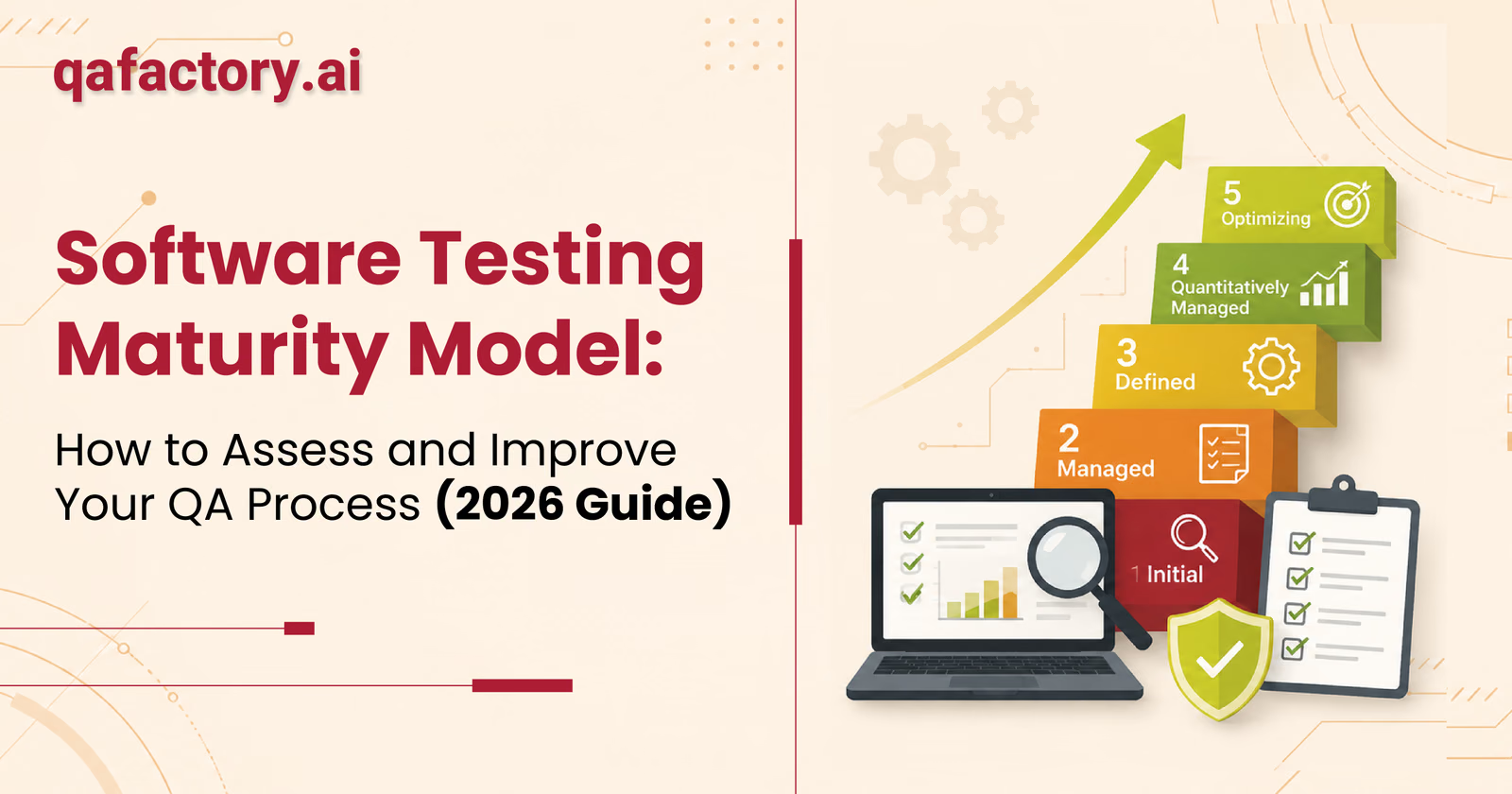
A software testing maturity model is a structured framework used to evaluate how disciplined, repeatable, and risk-informed an organization’s QA and testing processes are — typically scored across five levels from ad-hoc/reactive to optimized/predictive.
If you’ve ever sat in a release review wondering why the same categories of bugs keep slipping through, or why your team spends more time firefighting production issues than preventing them, you’re not dealing with a testing problem. You’re dealing with a maturity problem.
Most engineering organizations don’t have a tooling gap. They have a process gap. They’ve bought the automation frameworks, stood up the CI pipelines, and hired capable QA engineers — and defects still escape to production at a rate that keeps VPs of Engineering up at night. The reason is almost always the same: nobody has ever formally assessed how mature the QA process actually is, so improvement efforts end up scattered, reactive, and disconnected from business risk.
This guide breaks down what a software testing maturity model actually is, how to score your organization honestly against one, and how to move from ad-hoc testing to a governed, risk-based, continuously improving QA function. It also introduces QAFactory’s proprietary methodology — the ASCEND Framework — used with engineering leadership teams to turn maturity assessments into funded, sequenced improvement roadmaps.
This is not an article about testing techniques. If you’re looking for guidance on regression suites, coverage analysis, or test strategy documents, those are covered elsewhere. This article is about the organizational layer above all of that: governance, maturity scoring, process ownership, and the decisions that determine whether your QA function is a cost center or a competitive advantage.
What is a software testing maturity model?
A testing maturity model provides a benchmark — usually five levels — against which an engineering organization can measure its current QA practices in areas like test planning, defect management, automation coverage, metrics usage, and process governance. Unlike a single test strategy document, a maturity model evaluates the system that produces test strategies, execution discipline, and quality outcomes over time.
Without a maturity model, “improving QA” becomes a vague aspiration rather than a measurable initiative. Leadership can’t prioritize investment, engineering managers can’t justify headcount for automation, and QA teams end up reacting to the last incident instead of preventing the next one. A maturity model turns quality into something you can put a number on, track quarter over quarter, and tie to business outcomes like release velocity, defect escape rate, and customer-reported incidents.
- A testing maturity model assesses process, not just test coverage or tooling.
- Maturity is typically scored across five levels, from Initial/Ad-hoc to Optimizing.
- Maturity models originated from software process frameworks like the Capability Maturity Model (CMM) and were later adapted specifically for testing through frameworks such as TMMi (Test Maturity Model integration) and TPI (Test Process Improvement).
- A mature QA organization is defined by predictability and risk-based decision-making, not by the volume of test cases it runs.
- Assessing maturity is the first step in any credible QA transformation initiative.
In audit work with SaaS engineering teams, the single biggest predictor of production incidents isn’t test count or automation percentage — it’s whether the organization has a documented, owned process for deciding what to test based on risk, versus testing everything (or nothing) by default. Maturity models exist to expose that gap.
Organizations that formally assess and improve testing maturity typically see the improvement show up first in reduced production incident volume and faster, more predictable release cycles — because effort gets redirected from redundant low-risk testing toward the areas most likely to break.
Why testing maturity assessment matters more in 2026 than ever
SaaS engineering organizations are shipping faster, with smaller teams, under more competitive pressure than at any point in the last decade. AI-assisted development means code gets written faster than ever — which means the bottleneck has shifted decisively to quality assurance and release validation. At the same time, budgets for dedicated QA headcount have tightened in many organizations, and engineering leaders are expected to do more with fewer dedicated testers.
This combination creates a specific and dangerous failure pattern: velocity increases while QA maturity stays flat or even declines, because there’s no formal mechanism forcing leadership to evaluate whether the process underneath testing has kept pace with the volume of code being shipped.
A maturity assessment forces that conversation. It gives CTOs and VPs of Engineering a defensible, evidence-based way to answer questions like:
- Are we testing the right things, or just the most convenient things?
- Is our automation actually reducing risk, or just automating low-value checks?
- Do we have a repeatable process, or does quality depend entirely on which engineer is on call?
- What would it take to move from where we are to where we need to be — and what would that cost, and what would it save?
Without a maturity model, these questions get answered anecdotally, in a retro, after an incident. With one, they get answered proactively, with a score, a gap analysis, and a roadmap.
The origins of testing maturity models: TMMi, TPI, and CMM
Modern software testing maturity models trace back to the Capability Maturity Model (CMM), developed for software process improvement, later adapted specifically for testing through the Test Maturity Model integration (TMMi) and the Test Process Improvement (TPI) model.
The Capability Maturity Model was originally developed to help organizations assess and improve software development processes generally. Its core insight — that process discipline, not individual heroics, is what produces predictable outcomes at scale — was later applied specifically to testing. TMMi, maintained as an independent standard, defines maturity levels specifically for test processes, moving from an initial/chaotic level through managed, defined, measured, and optimizing levels. ISTQB (the International Software Testing Qualifications Board) has also published extensively on structured test process improvement, and its syllabi reference maturity concepts as a foundational part of test management competency.
QAFactory’s ASCEND Framework, introduced later in this guide, is built on these same underlying principles — but reorganized specifically for SaaS engineering organizations that need a practical, action-oriented assessment rather than a heavyweight certification process. TMMi and ISTQB concepts are referenced here because they’re the accepted intellectual foundation of this field, not because a formal certification is required to benefit from maturity thinking.
The five levels of software testing maturity
Most testing maturity models describe five levels: Initial/Ad-hoc, Managed, Defined, Measured, and Optimizing — moving from reactive, undocumented testing toward a predictive, data-driven, continuously improving quality function. Organizations don’t need to hit Level 5 to be successful — but they do need to know, honestly, which level they’re actually operating at, rather than which level they assume they’re at.
- Level 1 — Initial / Ad-hoc. Testing happens, but it’s inconsistent, undocumented, and highly dependent on individual engineers. There’s no formal test plan, no shared definition of “done,” and quality is discovered largely through user reports after release. Automation, if it exists, is fragmented and unowned.
- Level 2 — Managed. Basic test planning exists for major releases. Defects are tracked in a system (even if inconsistently), and there’s some separation between development and testing responsibilities. Processes are still reactive — testing effort is driven by deadlines rather than risk, with no consistent methodology across teams or products.
- Level 3 — Defined. The organization has a documented, standardized test process applied consistently across teams. Risk-based test prioritization exists. Automation coverage is deliberate rather than accidental, targeting regression-prone and high-traffic areas. QA has a defined role in the SDLC, not just a final gate before release.
- Level 4 — Measured. Quality metrics are tracked systematically — defect escape rate, test coverage by risk tier, automation pass rates, mean time to detect, and mean time to resolve. Decisions about where to invest testing effort are made based on data, not intuition. Release readiness is assessed against quantitative thresholds, not gut feel.
- Level 5 — Optimizing. Testing process improvement is continuous and built into how the organization operates. Metrics feed back into process changes automatically. The organization actively experiments with process improvements — new automation approaches, shift-left practices, predictive quality analytics — and measures whether they actually reduce risk. QA is treated as a strategic function with direct visibility to engineering leadership, not an execution-only team.
| Dimension | Level 1 (Initial/Ad-hoc) | Level 5 (Optimizing) |
|---|---|---|
| Test planning | Informal, tribal knowledge | Documented, risk-weighted, repeatable |
| Defect tracking | Inconsistent, scattered across channels | Centralized, categorized, trend-analyzed |
| Automation | Fragmented, unowned, frequently broken | Strategic, maintained, tied to risk tiers |
| Metrics | None, or vanity metrics only | Defect escape rate, MTTD/MTTR, coverage by risk |
| Release decisions | Based on deadline pressure | Based on quantitative release readiness criteria |
| Process ownership | No single owner | Clear QA governance and accountability |
| Improvement cycle | Reactive, post-incident only | Continuous, proactive, data-driven |
| Business visibility | QA invisible to leadership until something breaks | QA metrics reported alongside engineering KPIs |
Testing maturity model vs. test strategy: what’s the difference?
A test strategy defines what and how you’ll test for a specific product or release; a testing maturity model evaluates how capable and repeatable your organization’s overall testing process is, independent of any single project. This distinction trips up a lot of engineering leaders, so it’s worth being precise about it.
| Dimension | Test strategy | Testing maturity model |
|---|---|---|
| Scope | Project or product-specific | Organization-wide, process-level |
| Purpose | Defines testing approach for a release or system | Evaluates the capability and consistency of the testing process itself |
| Output | A strategy document, test plan, risk register | A maturity score, gap analysis, and improvement roadmap |
| Timeframe | Tied to a release cycle | Ongoing, reassessed periodically (e.g. quarterly or annually) |
| Owner | QA lead or test architect for the product | Engineering leadership, QA governance function |
| Changes when | The product or release scope changes | The organization’s process discipline changes |
In practice, mature organizations use both together: the maturity model tells you how good your process is at producing good test strategies consistently, while the test strategy tells you what that process should produce for this specific release. If you don’t have a documented test strategy approach yet, that’s actually a maturity signal in itself — it typically indicates a Level 1 or 2 organization.
Reactive QA vs. mature QA: a practical comparison
Reactive QA responds to problems after they occur — bugs found in production, last-minute test scrambles before release, and firefighting. Mature QA anticipates risk, tests proactively based on impact, and treats quality as a measured, managed discipline rather than a gate at the end of development.
| Behavior | Reactive QA | Mature QA |
|---|---|---|
| When testing happens | Right before release, under time pressure | Continuously, integrated into the development cycle |
| What gets tested | Whatever the tester remembers or has time for | Prioritized by business risk and historical defect data |
| How defects are handled | Triaged individually, often without root cause analysis | Tracked for patterns, feeding back into process changes |
| Automation approach | Built reactively after a production incident | Built proactively for high-risk, high-frequency-change areas |
| Release decisions | “We’re out of time, ship it” | “Here’s our risk profile and readiness score for this release” |
| Relationship with dev teams | QA seen as a bottleneck or gatekeeper | QA embedded as a collaborative, risk-informed partner |
| Leadership visibility | Quality issues surface as fire drills | Quality trends reported proactively, before they become incidents |
Manual-first vs. risk-based QA processes
A manual-first QA process defaults to executing the same broad manual test suite for every release regardless of risk; a risk-based QA process allocates testing effort — manual and automated — according to the likelihood and business impact of failure in each area of the system.
Many organizations conflate “more testing” with “better testing.” Maturity models push back on this directly. A Level 1 or 2 organization tends to run the same regression checklist for every release, regardless of what actually changed or how risky that change is. A Level 3+ organization builds a risk model — factoring in code churn, historical defect density, business criticality of the feature, and blast radius of a failure — and directs testing effort accordingly.
| Dimension | Manual-first / blanket testing | Risk-based QA |
|---|---|---|
| Test selection | Same suite every release | Selected based on change impact and risk score |
| Effort allocation | Uniform across all features | Weighted toward high-risk, high-traffic, high-change areas |
| Speed | Slows down as the product grows | Scales because low-risk areas get lighter coverage |
| Automation targeting | Ad-hoc or based on convenience | Targeted at highest-risk, highest-frequency-change paths |
| Failure discovery | Often in production, in low-priority-tested areas | Concentrated detection where it matters most |
This doesn’t mean manual testing is bad — it means undifferentiated testing effort is a maturity gap, whether it’s manual or automated.
Small startup vs. enterprise QA process: what should actually differ
Early-stage SaaS startups should prioritize lightweight, risk-based testing with fast feedback loops and minimal process overhead, while enterprise organizations need formal governance, cross-team standards, and compliance-aware documentation — but both should be assessed against the same underlying maturity principles, just at different scales.
A common mistake: early-stage companies try to adopt enterprise-grade QA governance too early, burning engineering time on process that doesn’t yet match their risk profile. The inverse mistake is just as common: enterprises with dozens of teams still running QA the way a five-person startup would, with no standardization, resulting in wildly inconsistent quality across products.
| Dimension | Small startup (seed–Series B) | Enterprise SaaS |
|---|---|---|
| Ideal maturity target | Level 2–3 | Level 3–5 |
| Test documentation | Lightweight, living documents | Formal, versioned, audit-ready |
| Automation focus | Core user flows and revenue-critical paths | Broad regression coverage plus compliance-driven testing |
| Governance | Single QA owner or embedded QA-minded engineers | Dedicated QA leadership, cross-team standards, review boards |
| Metrics | A few key indicators (escape rate, critical bug count) | Full metrics dashboard tied to engineering and business KPIs |
| Release cadence impact | Maturity gaps show up as customer churn risk | Maturity gaps show up as compliance and reputational risk |
How to assess your current QA maturity: a practical methodology
A QA maturity assessment combines structured interviews with engineering and QA staff, a review of existing artifacts (test plans, defect logs, automation coverage), and quantitative analysis of quality metrics, scored against a defined maturity rubric across process areas like planning, execution, automation, defect management, and governance.
An assessment is only useful if it’s evidence-based. Self-reported maturity (“we think we’re pretty good at testing”) is almost always overly optimistic, because leadership sees release outcomes, not the process gaps that produced them.
- Artifact review. Pull actual test plans, defect logs, automation reports, and release checklists from the last 3–6 release cycles. Don’t rely on descriptions of the process — look at what was actually produced.
- Structured interviews. Talk to QA engineers, developers, and engineering managers separately. Discrepancies between how different roles describe the process are themselves diagnostic — if QA says “we do risk-based testing” and developers say “we just run everything,” that’s a maturity gap in communication and process ownership, not just execution.
- Metrics analysis. Pull whatever quantitative data exists: defect escape rate, time-to-detect, time-to-resolve, automation pass/fail trends, and test coverage by area. If this data doesn’t exist or can’t be produced quickly, that itself indicates a lower maturity level — mature organizations can answer these questions in minutes, not weeks.
- Scoring against a rubric. Each process area — test planning, defect management, automation, metrics, governance — gets scored independently against the five maturity levels, because organizations are rarely uniform. It’s common to be Level 4 in defect tracking but Level 1 in automation strategy.
- Gap analysis and prioritization. The scored assessment gets translated into a prioritized list of gaps, weighted by business risk and effort to close, which becomes the input to a roadmap.
The most revealing assessment question isn’t about tools or coverage percentages — it’s “walk me through what happened the last time a critical bug reached production.” How an organization answers that question — calmly, with a documented postmortem and process change, versus defensively, with finger-pointing and no follow-up — tells you more about actual maturity than any self-reported score.
The QAFactory ASCEND Framework
The QAFactory ASCEND Framework is a six-stage methodology — Assess, Score, Close gaps, Establish standards, Normalize automation, and Drive continuous improvement — designed specifically to help SaaS engineering organizations move from ad-hoc testing to a governed, risk-based, continuously improving QA function.
Generic maturity models tell you where you stand. They don’t always tell you what to do next, in what order, with what resourcing. ASCEND was built by QAFactory specifically to close that gap — translating an assessment into a sequenced, ownership-assigned improvement plan that engineering leadership can actually execute against, quarter by quarter.
- 1 A — Assess current QA stateA structured, evidence-based evaluation of the existing testing process across five dimensions: planning, execution, automation, defect management, and governance, scored with a standardized rubric so results are comparable across teams and over time.
- 2 S — Score process maturityTranslate the assessment findings into a quantitative maturity score (1–5) per process dimension, using a weighted rubric that reflects which dimensions carry the most business risk for the specific product and industry.
- 3 C — Close quality gapsPrioritize and address the specific gaps identified in scoring, starting with the highest-risk, highest-impact areas rather than attempting to fix everything simultaneously.
- 4 E — Establish standardsDocument and formalize the testing practices that should be applied consistently across teams — test plan templates, defect severity definitions, release readiness criteria, and risk-based testing thresholds.
- 5 N — Normalize automationEnsure automation is applied strategically and consistently — targeting the highest-risk, highest-change-frequency parts of the system — rather than existing as a scattered collection of scripts with unclear ownership.
- 6 D — Drive continuous improvementBuild a recurring cadence — typically quarterly — where maturity is reassessed, metrics are reviewed against targets, and the roadmap is adjusted based on what’s actually moving the needle.
- Assess and score together. Score each dimension independently rather than producing a single blended number — a blended “Level 3, doing okay” can hide a critical bottleneck, like strong defect tracking sitting next to an unmaintained automation suite tied to none of the product’s actual risk areas.
- Close gaps by sequencing, not by trying to fix everything at once. Rank gaps on an impact-versus-effort matrix, assign a single accountable owner to each initiative, and set a defined timeframe — typically one quarter per major gap — with a measurable exit criterion.
- Establish standards with developer buy-in. Standards imposed without developer input tend to be ignored in practice. Build them as living documents with a defined review cadence, scaled to organization size.
- Normalize automation around risk, not test count. A smaller, well-maintained, risk-aligned automation suite consistently outperforms a large, unmaintained one — retiring low-value tests and redirecting that maintenance capacity toward the highest-incident-history workflows is often the single highest-leverage move available.
- Drive improvement on a fixed cadence. The single biggest failure mode in QA maturity initiatives isn’t a bad assessment — it’s a good assessment that never gets revisited. Build the reassessment cadence into the initial engagement, not as an afterthought.
QA maturity self-assessment checklist
Use this as a lightweight starting point before commissioning a formal assessment:
- We have a documented test plan process, not just tribal knowledge
- We track defects in a centralized system with consistent severity definitions
- We can produce a defect escape rate number for the last quarter within minutes
- Our automation coverage is mapped to actual production risk areas, not convenience
- We have a defined release readiness checklist applied consistently
- QA has a defined role earlier than “final gate before release”
- We review quality metrics with engineering leadership on a regular cadence
- We conduct root cause analysis on production incidents, not just triage
- Our test approach differs based on risk, not a single blanket process for every release
- We’ve reassessed our QA process formally within the last 12 months
Scoring: fewer than 5 checked boxes typically indicates Level 1–2 maturity. 6–8 typically indicates Level 3. 9–10 indicates Level 4–5.
Release readiness, process improvement, and governance checklists
Release readiness checklist:
- All critical and high-severity defects from this release cycle are resolved or explicitly risk-accepted by an accountable owner
- Automated regression suite has passed against the release candidate build
- Risk-based manual testing has been completed for all high-change-impact areas
- Rollback plan is documented and has been validated
- Monitoring and alerting are confirmed active for the affected components
- Release notes and customer-facing documentation are accurate and complete
- Sign-off has been obtained from QA, engineering, and product ownership
Process improvement checklist:
- Current maturity has been scored across all five dimensions, not just estimated
- Gaps are ranked by business impact, not just ease of implementation
- Each improvement initiative has a single accountable owner
- Each initiative has a defined, measurable exit criterion
- Improvement plan has been reviewed and approved by engineering leadership
- A reassessment date is already scheduled before work begins
Automation readiness checklist:
- Automation targets are selected based on risk and change frequency, not convenience
- There is a named owner responsible for automation suite maintenance
- Flaky or unreliable tests are actively tracked and remediated, not ignored
- Automation coverage is measured against risk tiers, not raw test count
- There is a clear criterion for what should not be automated (e.g. low-frequency exploratory scenarios)
- Automation results feed into release readiness decisions, not just CI logs nobody reviews
Leadership review checklist:
- Quality metrics are reviewed alongside standard engineering KPIs, not in a separate silo
- Maturity scores are reassessed on a defined cadence (quarterly or semi-annual)
- Investment decisions — headcount, tooling — are tied to identified maturity gaps
- Postmortems from production incidents are reviewed for process-level, not just code-level, root causes
- QA leadership has a standing voice in release and roadmap planning discussions
Common pitfalls when building a QA maturity roadmap
The most common pitfalls in QA maturity initiatives are treating the assessment as a one-time project instead of a recurring process, over-investing in automation before establishing risk-based standards, and failing to assign clear ownership for closing identified gaps.
- Automation-first thinking without a risk model. Organizations often jump straight to “we need more automated tests” without first establishing which areas of the system actually carry the most risk. This produces lots of automation and low actual risk reduction.
- Treating the assessment as a report instead of a roadmap. A maturity assessment that produces a document nobody revisits is functionally useless. The value is in the recurring cadence — reassess, reprioritize, execute — not the initial scorecard.
- No single owner for QA governance. In many mid-sized SaaS organizations, testing standards exist informally across multiple teams with no single accountable owner. Gaps don’t get closed because nobody is explicitly responsible for closing them.
- Conflating maturity with headcount. Adding QA engineers without addressing process discipline tends to just add more inconsistent testing at a higher cost. Maturity is a process property, not a staffing level.
- Ignoring developer experience. Standards imposed top-down without developer input tend to be worked around rather than followed. The most durable maturity improvements involve developers in defining what “good” looks like.
Building a QA maturity roadmap: from assessment to execution
A QA maturity roadmap translates assessment findings into a sequenced, quarter-by-quarter execution plan, prioritizing the highest-risk gaps first and building in a recurring reassessment cadence so the roadmap adapts as the organization improves.
- Sequencing. Don’t attempt every gap simultaneously. A typical sequence for an organization starting near Level 2 might look like: Quarter 1 — establish standards and release readiness criteria; Quarter 2 — normalize automation around risk tiers; Quarter 3 — build out metrics reporting and dashboards; Quarter 4 — reassess and set next-year priorities.
- Resourcing. Each gap-closing initiative needs a realistic time and people estimate. Underestimating the effort required to retrofit standards or automation into an existing, actively shipping codebase is one of the most common reasons roadmaps stall.
- Executive sponsorship. Maturity initiatives without visible support from a CTO or VP of Engineering tend to lose priority against feature deadlines. Roadmaps should include a defined reporting cadence to leadership specifically to protect that priority.
- Reassessment triggers. Beyond the standard quarterly cadence, certain events should trigger an off-cycle reassessment: a significant production incident, a major architectural change, rapid team growth, or entry into a new regulated market.
Illustrative example: early-stage SaaS startup QA maturity journey
Illustrative example — not an actual QAFactory client. Presented to demonstrate how the ASCEND Framework applies in practice.
A 20-person engineering team building a B2B workflow automation SaaS product had grown quickly, shipping new features weekly, but had never formally evaluated their testing process. Support tickets were manageable, but the team’s own engineers privately described releases as “nerve-wracking.”
An ASCEND assessment scored the organization at Level 1.5 overall, with the biggest gaps in test planning (no documented process) and automation (coverage limited to authentication flows). Following the assessment, the team established a single-page release readiness checklist, built automated regression coverage for their three highest-usage workflows, and began tracking defect escape rate for the first time. Within two quarters, their self-reported “nerve-wracking release” sentiment had measurably declined, and their defect escape rate — now actually being tracked — showed a clear downward trend as risk-based automation coverage expanded.
Illustrative example: enterprise SaaS company QA maturity journey
Illustrative example — not an actual QAFactory client. Presented to demonstrate how the ASCEND Framework applies in practice.
A 400-engineer enterprise SaaS platform serving regulated industries had extensive existing QA infrastructure — dedicated QA teams, established defect tracking, and a large automated test suite built up over several years. Despite this, release delays were increasing, and engineering leadership couldn’t explain why, given the apparent investment in QA.
A dimension-level ASCEND assessment revealed the disconnect: defect management scored Level 4, but automation strategy scored Level 2, because the large test suite had grown organically without being re-tied to actual production risk data as the product evolved. Roughly a third of automated tests covered low-risk, rarely-changed functionality, while several high-incident-history workflows had minimal automated coverage. Closing this gap involved retiring low-value tests and redirecting automation engineering capacity toward the highest-risk areas — a process that took one full quarter but directly addressed the release delay pattern leadership had been unable to diagnose through metrics alone.
Frequently asked questions
What is a software testing maturity model?
A software testing maturity model is a structured framework, typically with five levels, used to evaluate how disciplined, repeatable, and risk-informed an organization’s testing process is, independent of any single project or release.
What are the 5 levels of test maturity?
Most models describe five levels: Initial/Ad-hoc, Managed, Defined, Measured, and Optimizing, progressing from reactive, undocumented testing toward a predictive, continuously improving quality function.
What is TMMi?
TMMi (Test Maturity Model integration) is an independently maintained maturity model specifically focused on test process capability, building on the broader Capability Maturity Model concept applied specifically to software testing.
How is a testing maturity model different from a test strategy?
A test strategy defines what and how to test for a specific product or release; a testing maturity model evaluates the overall capability and consistency of the organization’s testing process across all releases.
How do you assess QA maturity?
QA maturity is typically assessed through a combination of artifact review (test plans, defect logs, automation reports), structured interviews across QA and engineering roles, and quantitative metrics analysis, scored against a defined maturity rubric.
What is a QA maturity assessment used for?
It’s used to identify specific process gaps, prioritize improvement initiatives based on business risk, and build a defensible, evidence-based roadmap for QA investment.
Do small startups need a formal testing maturity model?
Yes, though the target maturity level and process formality should be scaled appropriately — early-stage startups typically benefit most from reaching Level 2–3 with lightweight, risk-based processes rather than attempting enterprise-grade governance too early.
What is risk-based testing?
Risk-based testing allocates testing effort according to the likelihood and business impact of failure in different parts of a system, rather than applying uniform test coverage regardless of risk.
What’s the difference between reactive QA and mature QA?
Reactive QA responds to problems after they occur, often under release-deadline pressure; mature QA anticipates risk, prioritizes testing based on impact, and treats quality as a continuously measured and managed discipline.
How often should QA maturity be reassessed?
Quarterly reassessment is typical for fast-moving SaaS organizations, with semi-annual cycles more common for larger, slower-moving enterprises, plus off-cycle reassessment after major incidents or architectural changes.
What is the QAFactory ASCEND Framework?
ASCEND is QAFactory’s proprietary six-stage methodology — Assess, Score, Close gaps, Establish standards, Normalize automation, and Drive continuous improvement — designed to translate a QA maturity assessment into an executable, sequenced roadmap.
Is more test automation always a sign of higher maturity?
No. Automation volume without alignment to actual production risk is a common maturity gap in itself; a smaller, well-maintained, risk-aligned automation suite typically reflects higher maturity than a large, unmaintained one.
What metrics indicate QA maturity?
Common indicators include defect escape rate, mean time to detect and resolve defects, automation coverage measured against risk tiers, and consistency of release readiness criteria across teams.
Who should own QA process maturity in an organization?
Ideally a dedicated QA leadership role or engineering manager with explicit accountability; organizations without a single owner for QA governance tend to see standards applied inconsistently across teams.
What is defect escape rate?
Defect escape rate measures the proportion of defects discovered after release, in production, versus those caught during testing, and is one of the most commonly tracked indicators of QA process effectiveness.
Can a company be highly automated but still low maturity?
Yes — automation without risk-based targeting, ownership, and maintenance is a common pattern where organizations appear advanced on the surface but score low on process maturity when assessed on dimensions like planning and governance.
What’s the first step in improving QA maturity?
The first step is a structured, evidence-based assessment of the current state — self-reported estimates of maturity are consistently less accurate than assessments based on actual artifacts and metrics.
How does QA maturity affect release velocity?
Lower-maturity organizations often experience slowing release velocity as the product grows, because undifferentiated testing effort doesn’t scale; risk-based, mature processes allow testing effort to scale proportionally with actual risk rather than raw feature count.
What industries need higher QA maturity levels?
Regulated industries such as fintech, healthcare, and enterprise software handling sensitive data typically require higher maturity levels (Level 4–5) due to compliance requirements and the business impact of failures.
How does QAFactory help with QA maturity assessments?
QAFactory conducts structured QA maturity assessments using the ASCEND Framework, combining artifact review, stakeholder interviews, and metrics analysis to produce a dimension-level maturity score and a prioritized, sequenced improvement roadmap.
Where this fits into your broader QA strategy
A maturity assessment doesn’t replace the tactical work of good testing — it contextualizes it. Once you understand your organization’s maturity level and specific gaps, that assessment should inform decisions across your broader QA program, including:
- How you structure your test strategy for individual SaaS products and releases
- Which software testing KPIs you track and report to leadership
- Where you focus test coverage analysis efforts based on identified risk areas
- Whether your regression testing approach is risk-based or blanket-applied
- Whether a formal QA audit is warranted before a major release, funding round, or compliance milestone
- Whether ongoing QA outsourcing makes sense to close identified capability gaps quickly
- How you approach Playwright automation testing once automation targets are risk-mapped
- Specific considerations for mobile app QA testing and AI app QA testing, which often carry distinct risk profiles worth assessing separately
Ready to find out where your QA process actually stands?
Most engineering leaders are surprised by the gap between where they assume their QA maturity sits and what a structured assessment actually reveals. That gap is expensive — in production incidents, in engineering time spent firefighting, and in the opportunity cost of shipping slower than a risk-based process would allow.
QAFactory’s QA audit services apply the ASCEND Framework to give your organization a clear, evidence-based maturity score, a dimension-level gap analysis, and a prioritized roadmap your engineering leadership can actually execute against — not a generic report that sits unread after a single workshop.
Get a clear, honest picture of where your testing process stands today, and a concrete plan for closing the gaps that matter most to your business.
About this article: this guide was prepared by the QAFactory team as a practical reference for engineering leaders assessing and improving software testing maturity. It reflects current industry practice as of 2026.