QA as a Service (QAaaS): What It Is, Pricing and How It Works
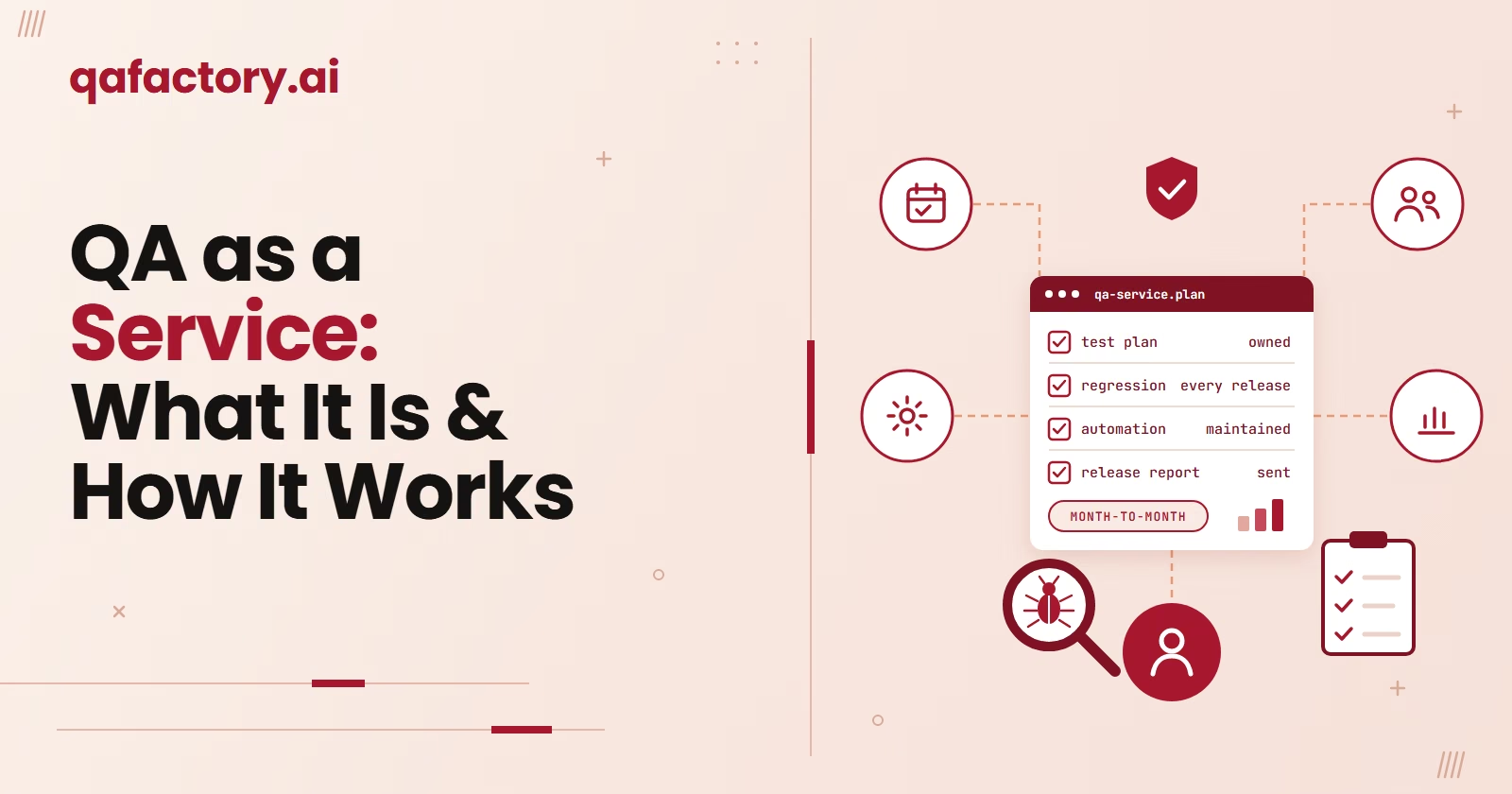
Short answer: QA as a Service (QAaaS) is a way to buy software testing as an ongoing service instead of hiring testers. An outside team owns test planning, execution, automation and reporting for your product, usually for a monthly fee, and works inside your tools and release process. It suits teams that ship often but do not want to build a QA department.
Key takeaways
- QA as a Service sells an outcome (tested releases) rather than hours. Check who owns the result before you compare prices.
- It is different from staff augmentation (you manage the tester), crowdtesting (many testers, short cycles) and project outsourcing (fixed scope, then it ends).
- A complete engagement covers test management, manual and automated testing, failure triage and a release report every cycle.
- Pricing usually follows one of four models: monthly retainer, per test run, per tester hour, or a fixed-scope audit.
- Start with a short audit or a pilot on three to five critical journeys before you commit to a longer plan.
| Topic | QA as a Service at a glance |
|---|---|
| What is it? | Ongoing software testing bought as a service, with the provider owning the result of each release |
| Also called | QAaaS, testing as a service (TaaS), managed QA, managed testing services |
| Who is it for? | Product teams that release weekly or faster without a dedicated QA department |
| What is included? | Test planning, test cases, manual and automated testing, failure triage, release reports |
| Typical price | Varies widely by provider: US QA services run about $5,000–$50,000+ per month, while QAFactory starts at $2,499 per month |
| Time to first results | Days. QAFactory delivers first findings within 48 hours |
What is QA as a Service?
QA as a Service is a delivery model for software testing. Instead of hiring and managing testers yourself, you subscribe to a provider that takes responsibility for testing your product on an ongoing basis. The provider brings the people, the process and usually the tooling, and fits its work to your release cadence.
The name borrows from software as a service: you pay for a running capability instead of building it. Vendors also call it testing as a service (TaaS), managed QA or managed testing. The labels vary. What matters is who owns the result when a release goes out.
How is QA as a Service different from other QA models?
The difference is ownership. With QA as a Service the provider manages the testers and owns the result of every release; with staff augmentation or an in-house team, you do.
| Model | Who manages the testers | Who owns the result | Typical length | Best for |
|---|---|---|---|---|
| In-house QA team | You | You | Permanent | Large products with steady, long-term QA needs |
| Staff augmentation | You | You | Months | Adding people to a QA process you already run |
| Project outsourcing | Provider | Provider, for a fixed scope | Weeks to months | A one-off launch, migration or certification |
| Crowdtesting | Provider platform | Shared | Days per test cycle | Real devices and locations at short notice |
| QA as a Service | Provider | Provider, every release | Ongoing, often month-to-month | Teams that release often without a QA department |
If you are still deciding whether to keep testing in-house at all, our guide to outsourced vs in-house QA compares the costs and trade-offs in detail.
What does a QA as a Service engagement include?
A complete engagement covers six jobs: test planning, test case management, manual testing, automation, failure triage and release reporting.
- Test strategy and planning: a risk map of your critical user journeys, agreed with your team, and a plan for what gets tested in each release.
- Test case management: written test cases and suites, kept current as features change, in a shared test management workspace.
- Manual and exploratory testing: new features, edge cases and the areas where scripted checks are weak.
- Test automation: Playwright, Cypress or Appium checks for stable journeys, written and maintained by the provider as part of a regression suite.
- Failure triage and bug reports: every failure reproduced before it reaches your engineers, then reported with severity, steps, environment and evidence.
- Release reporting: what was tested, what failed, which issues are known, and whether the release is ready.
Which kinds of testing does it cover?
Most engagements start with the testing every release needs and add specialist work as the product grows:
- Functional testing: features, business rules, roles and integrations behave as specified. See functional testing services.
- Regression testing: existing features still work after every change. See regression testing services.
- End-to-end testing: complete journeys such as sign-up, checkout and billing across every system they touch. See end-to-end testing.
- Mobile testing: iOS and Android apps on real devices, networks and OS versions. See mobile app QA.
- Load testing: API latency, throughput and concurrency before a launch. See API load testing.
For a neutral checklist, the ISTQB Certified Tester Foundation Level syllabus lists the activities a complete test process covers: planning, monitoring and control, analysis, design, implementation, execution and completion. A QA as a Service provider should be able to show you where each one happens in its service.
How does QA as a Service work?
It runs in five stages, from access to ongoing upkeep, and a good provider reports the first real bugs within days.
- 1 Scope and access.The provider learns the product, gets staging access and test accounts, and maps the journeys that matter most to revenue and trust.
- 2 First findings.An exploratory pass on the riskiest flows produces a first set of real, reproducible bugs, usually within days.
- 3 Repeatable coverage.Test cases are written for the critical journeys, and the most stable ones are automated and connected to your CI pipeline.
- 4 Release cycle.Before each release the provider runs the agreed checks, triages every failure and sends a release report.
- 5 Ongoing upkeep.Tests are updated as the product changes, and coverage grows wherever a bug escapes to production.
At QAFactory this is the job of a named Forward Deployed QA Engineer, who joins your Slack, Jira, Linear or GitHub and keeps tests, runs and evidence in the QAFactory.ai workspace. Our QA testing process page shows what each of the first four weeks delivers.
How much does QA as a Service cost?
It depends on scope, release frequency and the type of provider, and many providers sell it as a monthly retainer. Our QA testing services cost guide puts QA services in the USA at $25–$200 per hour, or $5,000–$50,000+ per month, depending on the type of provider. These are the four pricing models you will meet:
| Model | How it works | Watch out for |
|---|---|---|
| Monthly retainer | A flat fee for a named engineer or team | What happens to the price when release volume grows |
| Per test run | You pay each time an automated test executes | Costs that rise with every test you add |
| Per tester hour | Hourly or daily rates for testing time | Paying for hours rather than coverage |
| Fixed-scope audit | One price for a defined review and report | Reports that give a score without evidence |
QAFactory publishes its prices: a 48-hour QA audit from $299 and ongoing Forward Deployed QA from $2,499 per month, month-to-month, with the platform included. To see how other managed QA providers price their services, read our QA Wolf alternatives comparison.
How do you measure whether QA as a Service is working?
Count outcomes, not test cases. DORA’s software delivery performance metrics give engineering and QA a shared language. Change fail rate, the ratio of deployments that need immediate intervention, should fall as coverage improves, without slowing deployment frequency or change lead time.
- Escaped bugs: production bugs per release that the agreed tests should have caught.
- Change fail rate: the share of deployments that need immediate intervention after release.
- Time to coverage: days from a feature landing to having tests for it.
- Engineer time: hours your developers still spend testing or chasing failures.
- Report quality: whether an engineer can fix a bug from the report alone, without asking a question.
When does QA as a Service make sense?
It makes sense when you release often and nobody owns testing full time. It makes less sense when outside access is impossible or releases are rare.
- Good fit: you release weekly or faster, developers do most of the testing, there is no QA lead, and you need coverage in weeks rather than after a hiring cycle.
- Good fit: you have automation nobody maintains, or a regression checklist that takes days to run by hand.
- Poor fit: rules that prevent any outside access to your test environments, or a product that only releases a few times a year.
- Poor fit: you already run a mature QA team and only need extra hands. Staff augmentation is simpler for that.
What are the risks of QA as a Service?
The main risks are lost context, shallow coverage, data exposure and lock-in. Each one can be managed if you plan for it from the start:
| Risk | What it looks like | How to reduce it |
|---|---|---|
| Lost product context | Testers who do not understand why a feature exists miss the bugs that matter | Ask for a named engineer who joins planning and stays on your account |
| Shallow coverage | Many passing tests, but the risky journeys are untested | Agree a risk map first and review coverage against it every month |
| Data and access exposure | Outside testers working with real customer data | Use staging with test accounts and synthetic data, and limit access to what testing needs |
| Vendor lock-in | Tests and history live in a tool you cannot take with you | Require tests in open frameworks such as Playwright or Cypress, plus an export of cases and history |
| Slow feedback | Bug reports arrive after the release has already shipped | Agree when testing runs in your release cycle and where results appear |
What should you ask a QA as a Service provider?
Ask who does the work, who maintains it, how your data is handled, what you keep if you leave, and what makes the price rise. These eight questions cover it:
- 1 Who exactly will test our product?Ask whether the same person stays on your account, and what happens when they are away.
- 2 Who updates tests when our UI changes?And how quickly. Maintenance is where many automation efforts fail.
- 3 Who investigates failures?A failure should be reproduced and confirmed before it reaches your engineers.
- 4 What does a bug report contain?Ask for a real, anonymized example with severity, steps, environment and evidence.
- 5 How do you handle our data and access?Ask which environments testers use, whether real customer data is ever involved, and how access is granted and removed.
- 6 Do we own the tests if we leave?Test cases, scripts and history should come with you in a format you can run elsewhere.
- 7 What makes the price go up?More tests, more runs, more environments or more people. Know the answer before you sign.
- 8 How long until the first useful findings?Days is normal for a good provider. Weeks of onboarding before any bug is reported is a warning sign.
For a fuller vendor checklist, see how to choose a QA testing company.
Want to see QA as a Service on your own product before you commit? Start with a 48-hour QA audit from $299, or book a call to talk through your release process.
Frequently asked questions
What does QA as a Service mean?
It means buying software testing as an ongoing service. An outside provider owns test planning, execution, automation and reporting for your product, usually for a monthly fee, instead of you hiring and managing testers.
Is QA as a Service the same as outsourced QA?
It is one form of outsourced QA. Outsourcing can also mean a fixed-scope project or extra testers you manage yourself. QA as a Service is ongoing, and the provider owns the result of every release.
How much does QA as a Service cost?
QA services in the USA typically run $25–$200 per hour or $5,000–$50,000+ per month, depending on the provider. QAFactory publishes a 48-hour audit from $299 and managed QA from $2,499 per month.
What is the difference between QA as a Service and crowdtesting?
Crowdtesting sends short test cycles to many testers on real devices and locations. QA as a Service gives you a continuous owner who keeps coverage, automation and reporting current from release to release.
Do we need our own QA lead to use QA as a Service?
No. The provider owns the test strategy. Someone on your side should set priorities and answer product questions, which is usually a product manager or engineering lead.
How quickly can QA as a Service start?
A good provider reports its first findings within days of getting access. QAFactory delivers the first prioritized findings within 48 hours.
What is the difference between QA as a Service and testing as a service?
In practice they mean the same thing: testing delivered as an ongoing service by an outside provider. Some vendors use testing as a service for tool access alone, so check whether people, process and maintenance are included.
How do you outsource QA testing for a SaaS product?
Pick three to five critical user journeys, give a provider staging access and test accounts, agree how bugs are reported and where results appear, and run a short pilot before you sign a longer plan.
How do you compare QA testing service pricing?
Compare what each price includes, not only the number: who maintains tests, who triages failures, how coverage is measured and what makes the price rise. A per-run price and a monthly retainer can only be compared at your real test volume.
About this article: written by Lucia Martinez for QAFactory, which sells QA as a Service and is mentioned in this guide. The ISTQB and DORA references were checked against their official pages on Nov 27, 2026.