Outsourced QA vs. in-house QA: the true cost, velocity, and ROI guide for SaaS (2026)
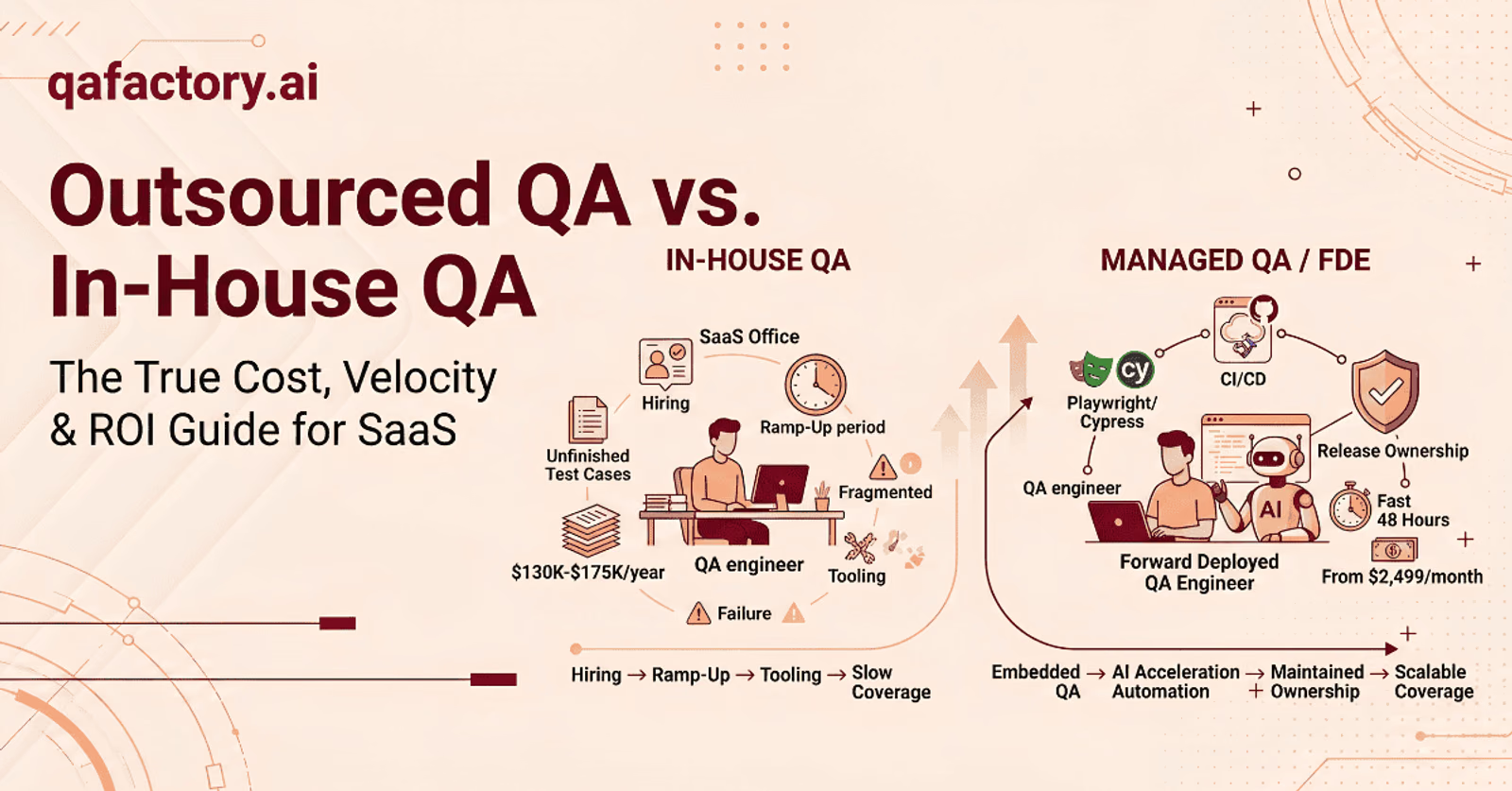
Cursor and Copilot didn’t just speed up how fast your engineers write code — they broke the feedback loop that used to keep quality in check. A senior engineer can now ship a feature in a day that would have taken a week in 2022. Your QA process, if it hasn’t changed since 2022, is now the bottleneck standing between that code and production.
This is the real tension SaaS teams are living with in 2026: development velocity scaled 3-5x with AI tooling, but testing capacity didn’t scale with it. Manual regression cycles that used to comfortably fit inside a two-week sprint now can’t keep pace with daily deploys. Automated suites, if they exist, rot faster than anyone can maintain them. And the traditional answer — “just hire a QA engineer” — comes with a hiring timeline measured in months, not days.
Most teams try to patch the gap with the tools they already have. A backend engineer gets pulled off feature work to run a manual smoke test before a Friday deploy. A junior PM starts clicking through the checkout flow by hand because “someone has to.” An existing Cypress suite that used to pass reliably starts failing for reasons nobody investigates, so the team mutes it and ships anyway. None of this is a testing strategy — it’s improvisation under pressure, and it’s exactly why release-day anxiety has crept back into teams that thought CI/CD had already solved it.
So the real question isn’t “outsourced QA vs. in-house QA.” That framing is outdated. The real question is who owns testing accountability for your releases — and whether that ownership scales with your shipping cadence or lags behind it. A hire that takes a quarter to ramp doesn’t scale with weekly releases. A contractor who disappears after handing off a test script doesn’t own anything past the invoice. This guide breaks down the true cost, the hidden failure modes, and the ROI math behind each model, so you can make the call with real numbers instead of gut instinct.
The true total cost of ownership (TCO) of an in-house QA engineer
The job posting says $90k–$130k/year. That number is the floor, not the total. Here’s what actually shows up on your P&L once you factor in everything around the hire.
- Recruiting fees and overhead. If you’re using a recruiter or agency, expect 15–20% of first-year base salary as a placement fee. On a $110k hire, that’s $16,500–$22,000 before the engineer has written a single test case. Run it in-house through your talent team, and you’re still absorbing weeks of sourcing, screening, and interview loops that pull your engineering managers away from shipping.
- Ramp-up and context-building delay. A QA hire doesn’t walk in and immediately protect your release pipeline. They need 60–90 days to learn your product’s critical flows, your codebase’s fragile edges, your team’s tooling, and your release cadence well enough to catch the bugs that matter instead of the bugs that are easy to find. During that window, you’re paying full salary for partial output.
- Tooling and infrastructure. A single QA engineer rarely comes with a full test management stack. Add BrowserStack or a comparable cross-browser grid, a dedicated test case management tool, CI cloud runners for parallel execution, and reporting dashboards — realistically $300–$800/month in fragmented subscriptions that someone has to procure, configure, and maintain.
- Management overhead. Someone owns this hire’s onboarding, 1:1s, performance reviews, and day-to-day unblocking — usually an engineering manager whose time is already the scarcest resource on the team. That’s a real cost even if it never appears on an invoice.
- Backfill risk. QA is a role with real turnover — the average tenure for a QA engineer at a Series A–C SaaS company runs 18–24 months. Every time that seat opens up, you’re paying the ramp-up cost again, and coverage quietly degrades in the gap between departure and replacement. The cost of hiring a QA engineer for a startup isn’t a one-time line item — it’s a recurring one that most budgets don’t model correctly.
Here’s what the annual number actually looks like once everything is stacked:
| Cost component | Low estimate | High estimate |
|---|---|---|
| Base salary | $90,000 | $130,000 |
| Recruiting fee (15–20%) | $13,500 | $26,000 |
| Tooling & infrastructure (annualized) | $3,600 | $9,600 |
| Ramp-up productivity loss (~2 months) | $15,000 | $21,700 |
| Management/overhead (est.) | $8,000 | $12,000 |
| Total annual cost | ~$130,000 | ~$175,000 |
And that’s for one engineer covering one product surface. Most B2B SaaS products need coverage across web, mobile, API, and integration layers — which means the real number to scale coverage is a multiple of this table, not a fraction of it. Scale to a second hire for redundancy — the reasonable move once QA becomes a single point of failure — and you’re looking at $260,000–$350,000/year before you’ve added a single point of automated coverage beyond what one person can physically maintain.
The hidden pitfalls of traditional QA contractors & freelancers
Faced with that TCO, plenty of teams route around it by hiring a contractor or a QA agency on a project basis. It’s cheaper on paper, but it introduces a different set of failure modes that tend to surface right when you need reliability most.
- No product context, no release ownership. A freelancer working across five clients doesn’t carry the mental model of why your billing flow works the way it does, or which edge case broke your RBAC permissions last quarter. They test what’s in the ticket. They don’t own the go/no-go call on your release — you still do, which means the accountability never actually left your team.
- The flaky automation trap. Contractors frequently hand off a Playwright or Cypress suite as the “deliverable.” The problem: test scripts rot the moment UI selectors change. Without someone embedded in your sprint cadence, nobody updates the suite when a component gets refactored, and within a few sprints your CI pipeline is red for the wrong reasons — flaky, unmaintained tests that engineers learn to ignore rather than trust.
- Noisy reports that create more work, not less. A bug list with screenshots but no reproduction steps, priority ranking, or root-cause context means your developers still have to triage every item manually. You paid for testing and still absorbed the triage labor in-house. This is the single most common reason SaaS teams abandon traditional QA outsourcing after one bad cycle.
- Misaligned incentives. Most agency contracts bill by the hour or by the test case executed, not by outcome. That structure rewards volume of activity over quality of coverage — more test cases logged, more hours billed, with no direct incentive tied to whether your production incident count actually goes down. The contractor’s success metric and your team’s success metric point in different directions from day one.
Taken together, these pitfalls explain why “just outsource it” so often becomes a cautionary tale instead of a cost-saving win. The problem was never outsourcing itself — it was outsourcing without ownership.
The modern alternative: managed QA & Forward Deployed QA engineers
The gap between “too expensive to hire” and “too unreliable to outsource” is where Managed QA Services live — specifically the Forward Deployed QA Engineer (FDE) model.
- What is a Forward Deployed QA Engineer? An FDE isn’t a ticket-taking contractor. They’re embedded in your workflow the way a full-time hire would be: they attend your sprint planning, they know your product’s critical revenue paths, and — critically — they own the go/no-go verdict on releases, the same accountability you’d expect from an in-house lead.
- Human judgment plus AI acceleration. AI tooling is genuinely useful for QA — it can generate exploratory test scenarios, flag likely regression zones from a diff, and triage failure noise faster than a human scanning logs. But AI shouldn’t be the one deciding whether a payment flow is safe to ship. The FDE model uses AI to accelerate scenario coverage while keeping a human engineer accountable for the release decision — which is the difference between a tool and a teammate.
- Zero tooling tax. Because the AI Test Management Platform is bundled in, you’re not stitching together BrowserStack, a separate test case manager, and a reporting layer. Test cases, execution history, and bug reports live in one system that integrates directly with Playwright, Cypress, Jira, Linear, GitHub, GitLab, and Slack — the tools your engineering team is already using.
Comprehensive comparison matrix
| Factor | In-house hire | Traditional agency / freelancer | QAFactory (managed QA) |
|---|---|---|---|
| Time to first bug report | 60–90 days (ramp-up) | 1–2 weeks (limited context) | 48 hours |
| Full annual cost | $130,000–$175,000 | $60,000–$120,000 (+ tooling & triage labor) | From $2,499/month (~$30,000/yr) |
| Test ownership | Yes, but slow to build | No — reports back to your team | Yes, from week one |
| UI change & maintenance | Manual upkeep by hire | Frequently neglected (flaky suite) | Actively maintained by FDE |
| Failure triage & verification | Done by the hire directly | Pushed back to your developers | Owned by the FDE, pre-verified |
| Tooling included | No — separate subscriptions | Rarely | Yes — full platform included |
| Scalability | Slow (new hires needed) | Inconsistent across projects | Scales with release cadence |
The SaaS QA decision framework: when should you outsource vs. hire?
If you’re weighing when to outsource QA testing versus building an internal team, these five signals mean the decision is already overdue:
- Engineers spend more than 20% of a sprint on manual smoke testing. Every hour a backend engineer spends clicking through a signup flow is an hour not spent on the roadmap.
- Revenue-critical flows keep regressing post-release. Signup, checkout, billing, and RBAC permissions breaking after a deploy isn’t a bad-luck streak — it’s a coverage gap.
- A major launch or investor demo is coming up. You need risk mitigation now, not after a 90-day ramp-up.
- Your Playwright or Cypress suite is red in CI and everyone ignores it. A failing suite nobody trusts is worse than no suite at all.
- Your hiring roadmap can’t keep pace with your release frequency. If product ships faster than QA headcount can grow, the gap only widens.
If two or more of these are true for your team today, the math favors regression testing services or a full managed QA engagement over waiting on a hiring cycle.
It’s worth being explicit about the counter-case too: if you’re a team of 50+ engineers with a dedicated QA leadership function already in place, and testing is a core differentiator of your product (a testing tools company, for instance), a fully in-house team likely makes sense long-term. Managed QA isn’t a replacement for every internal QA function — it’s the fastest path to accountable coverage for teams that are shipping faster than their current testing capacity can absorb, which describes the overwhelming majority of Series A–C SaaS companies today.
How Forward Deployed QA compounds over time (sprint 1 to sprint 8)
Coverage under the FDE model isn’t static — it compounds sprint over sprint as the engineer builds context on your product:
- 1 Sprint 1–2Coverage focused on critical revenue flows — signup, auth, checkout, billing. Baseline regression suite established against your existing Playwright/Cypress setup.
- 2 Sprint 3–4Expansion into secondary flows and permission edge cases (RBAC, multi-tenant access). Flaky tests identified and stabilized.
- 3 Sprint 5–6Cross-browser and mobile viewport coverage added. Integration points with third-party APIs brought under regression.
- 4 Sprint 7–8Comprehensive multi-browser regression suite in place, integrated into GitHub Actions/CI, with the FDE owning release verdicts as a standing part of your sprint cadence.
By week eight, you’re not looking at a patchwork of tickets — you’re looking at a maintained, compounding test asset that gets stronger with every release instead of decaying like an unmaintained contractor handoff.
Frequently asked questions
Is managed QA secure enough for SOC 2 or enterprise compliance requirements?
Yes. A properly structured managed QA engagement operates under the same access controls, NDAs, and data-handling practices you’d require of any embedded team member, with scoped access to staging and production environments as needed for your compliance posture.
Does this integrate with our existing CI/CD pipeline?
Yes — Forward Deployed QA is designed to plug into GitHub Actions, GitLab CI, Jira, and Linear directly, so test runs and bug reports live inside the tools your team already uses rather than a siloed dashboard.
What happens when our UI changes frequently?
This is exactly the failure mode that breaks traditional automation. An embedded FDE maintains the suite as part of the engagement, updating selectors and scenarios as your product evolves instead of letting the suite go stale.
How flexible is the contract if our needs change?
Managed QA engagements are typically structured month-to-month, letting you scale coverage up before a launch and down during quieter periods — a flexibility a full-time hire’s compensation structure doesn’t allow.
How is this different from just running a one-time audit?
An audit is a snapshot — useful before a launch or when you need an immediate risk read. A Forward Deployed QA engagement is ongoing, sprint-embedded ownership. Many teams start with the audit and convert to the full engagement once they see the gap it surfaces.
Conclusion: your next move
The in-house vs. outsourced framing misses the real decision in front of you: whether testing accountability scales with how fast your team ships, or lags behind it by a hiring cycle. A full-time hire costs $130k–$175k a year and takes a quarter to ramp. A traditional contractor is cheaper but pushes triage labor right back onto your developers. A Forward Deployed QA engineer gives you embedded ownership, AI-accelerated coverage, and a bundled platform — starting at $2,499/month.
If you have a release coming up and need a risk read before it ships, start with the 48-Hour QA Audit ($299) — a critical-flow assessment and prioritized bug report with video, delivered in two days. If you’re ready to close the gap between shipping velocity and testing coverage for good, book a demo with a Forward Deployed QA Engineer and see what month-to-month managed QA looks like for your team.
About this article: this guide was prepared by the QAFactory team as a practical reference for engineering and business leaders evaluating QA staffing models. It reflects general SaaS hiring, outsourcing, and QA engagement practices as of 2026.