Continuous QA for SaaS: the complete guide to continuous quality assurance
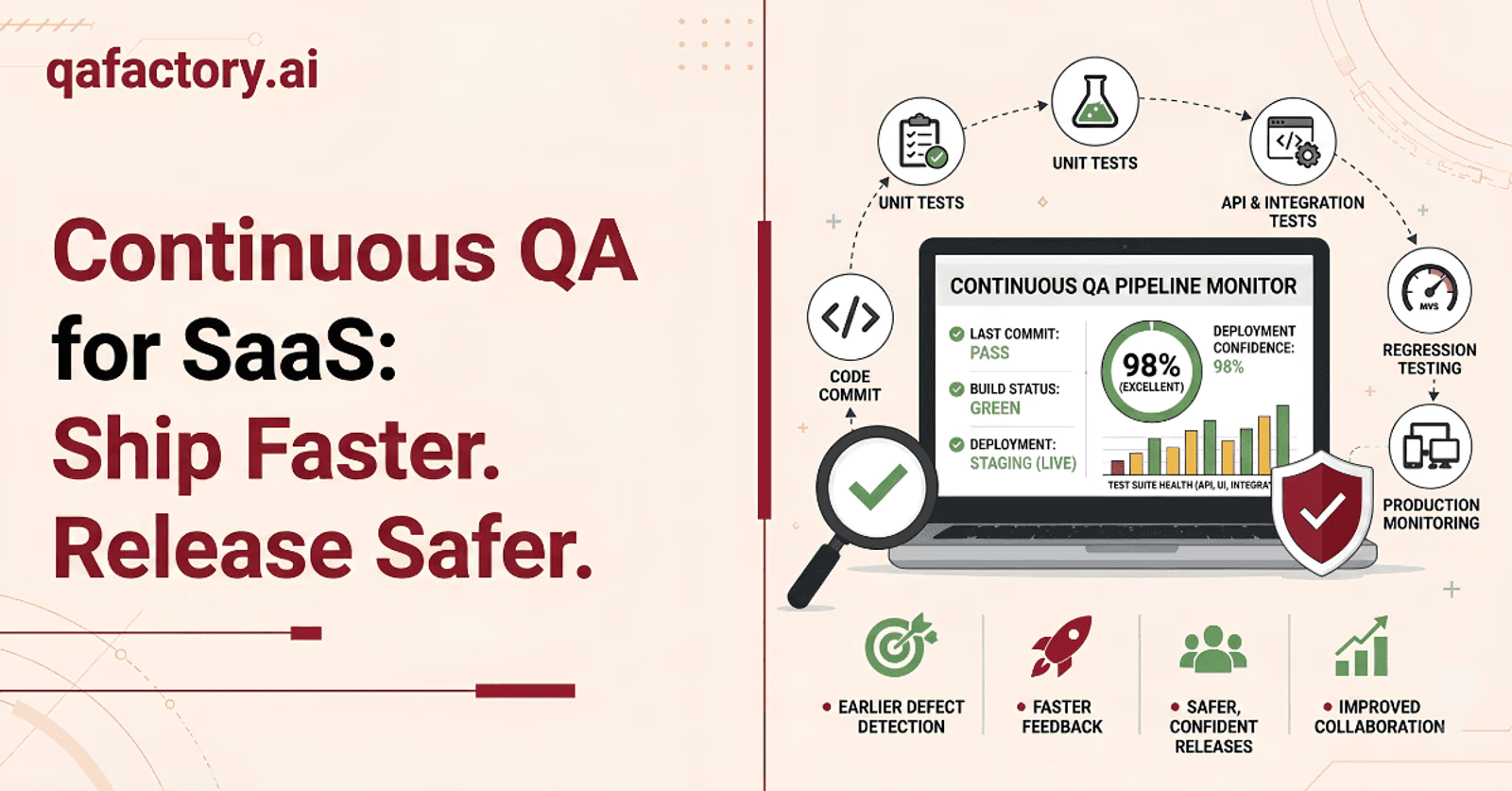
Continuous QA for SaaS is an ongoing quality assurance practice where automated testing, regression checks, and quality validation run throughout every stage of the software development lifecycle — not just before release. For SaaS teams shipping frequent updates through CI/CD pipelines, continuous quality assurance ensures defects are caught early, releases are safer, and product quality is maintained across every deployment.
SaaS products don’t follow a traditional release model. They ship continuously — weekly updates, daily hotfixes, feature flags, multi-region deployments. When quality assurance only happens at the end of a development cycle, testing becomes a bottleneck at exactly the moment it can cause the most damage.
A regression introduced in one service can cascade through integrations. A broken API response can silently degrade functionality for thousands of users before it’s detected. Manual QA at the gate simply cannot scale alongside the velocity that modern SaaS development demands.
This is the core problem that Continuous QA for SaaS solves.
What is Continuous QA for SaaS?
Continuous QA (Continuous Quality Assurance) is the practice of embedding quality validation throughout every phase of software development — from the moment a developer commits code to production monitoring after deployment.
It’s worth distinguishing three terms that are often used interchangeably but represent different scopes:
- Traditional QA — testing performed at the end of a development cycle, typically by a separate QA team validating a completed build before release.
- Continuous testing — automated tests executed within a CI/CD pipeline to provide fast feedback on code changes.
- Continuous QA — a broader discipline that includes continuous testing, but also encompasses test strategy, test environment management, test data governance, regression coverage planning, production monitoring, and ongoing quality improvement.
Continuous QA for SaaS, therefore, is not just “running tests in a pipeline.” It is a systematic, ongoing approach to software quality assurance that spans the entire development and deployment lifecycle.
Why Continuous QA matters for SaaS companies
SaaS teams that integrate quality assurance continuously — rather than periodically — gain practical engineering and business advantages:
- Earlier defect detection. Bugs caught at the unit or API layer cost significantly less to fix than those discovered in staging or production.
- Faster development feedback. Developers receive test results within minutes of committing code, enabling quicker corrections without context-switching delays.
- Safer, more confident releases. Regression coverage runs automatically on every build, reducing the risk of shipping previously fixed bugs.
- Reduced manual testing bottlenecks. Automating repetitive regression and integration checks frees QA engineers to focus on exploratory testing and high-risk areas.
- Improved cross-team collaboration. When QA is embedded in the development workflow rather than bolted on at the end, development and QA teams share ownership of quality.
- Continuous regression protection. In a SaaS product with ongoing feature development, regression testing for SaaS must run constantly — not occasionally.
How Continuous QA works in a SaaS CI/CD pipeline
A well-implemented Continuous QA workflow integrates quality validation at multiple points in the development lifecycle:
Code change → build triggered → unit tests → API tests → integration tests → UI/regression tests → quality gate → staging deployment → extended regression suite → production deployment → monitoring & alerting → feedback loop.
Quality gates — automated pass/fail thresholds — prevent a build from progressing to the next pipeline stage if critical tests fail. This ensures defects do not accumulate silently across deployments.
Production monitoring closes the feedback loop: real-world errors, performance degradation, and API failures inform which areas of the product require expanded test coverage.
Key components of Continuous QA for SaaS
A mature Continuous QA strategy for a SaaS product typically incorporates multiple testing layers. The right combination depends on the product’s architecture, release frequency, and risk profile — not every layer needs to run at every pipeline stage.
- Unit testing — validates individual functions and components at the code level; typically owned by developers.
- API testing — verifies that service endpoints return correct responses, handle errors appropriately, and maintain contract integrity across services.
- Integration testing — confirms that multiple services, modules, or third-party integrations work correctly together.
- UI/end-to-end testing — validates critical user journeys through the browser or application interface.
- Regression testing — ensures that new code changes have not broken existing functionality; essential for SaaS products with frequent releases.
- Cross-browser and responsive testing — confirms consistent behavior across browsers and screen sizes.
- Performance testing — identifies latency, throughput, and scalability issues before they affect users.
- Security testing — checks for common vulnerabilities, such as those documented by OWASP, including injection flaws, authentication weaknesses, and insecure configurations.
- Production monitoring — continuous observation of live system behavior to detect errors and anomalies that tests may not anticipate.
Continuous QA vs. traditional QA
| Area | Traditional QA | Continuous QA |
|---|---|---|
| Testing timing | End of development cycle | Throughout the entire SDLC |
| Feedback speed | Days to weeks | Minutes to hours |
| Automation | Partial or manual-heavy | Automation-first approach |
| Regression testing | Periodic, often manual | Automated and continuous |
| CI/CD integration | Typically none or minimal | Deeply integrated |
| Release model | Infrequent, scheduled | Frequent, continuous |
Continuous QA best practices for SaaS teams
- Automate regression tests first. Repetitive regression scenarios are the highest-value automation target — they run on every build and protect existing functionality.
- Integrate QA into the CI/CD pipeline. Tests should trigger automatically on every code change, not run manually by request.
- Prioritize by business risk. Not all tests are equal. Focus automation effort on workflows that are critical to revenue, user retention, or core product functionality.
- Maintain stable, consistent test environments. Flaky tests often originate from environment inconsistencies rather than code defects. Invest in reliable staging infrastructure.
- Keep the test suite fast. Long-running test suites slow CI/CD pipelines and discourage execution. Structure suites into fast feedback layers (unit, API) and slower extended suites (UI, performance).
- Invest in API and integration testing. For SaaS products with microservices or third-party integrations, API-level testing provides high coverage with lower maintenance overhead than UI tests.
- Monitor and address flaky tests immediately. Unreliable tests erode team trust in automation. Track flakiness and triage it as technical debt.
- Use production failures to guide test coverage. When a production defect is identified, add a test case that would have caught it. This prevents recurrence and grows coverage organically.
- Manage test data carefully. Tests that depend on inconsistent or shared data produce unreliable results. Maintain isolated, controlled test datasets.
- Review and update tests as the product evolves. Test suites become outdated as features change. Treat test maintenance as an ongoing engineering responsibility.
Common Continuous QA challenges
- Flaky automation is one of the most disruptive problems in any automated QA program. Tests that intermittently pass or fail — regardless of code changes — reduce confidence in the entire suite. Track test stability metrics and triage flaky tests proactively.
- Slow test suites create pipeline bottlenecks and incentivize teams to skip testing. Parallelization, test selection strategies, and splitting suites into tiers can significantly reduce feedback time.
- Unstable test environments cause false failures that are difficult to diagnose. Treating test environments with the same discipline as production infrastructure reduces this problem considerably.
- Excessive UI automation is a common mistake. UI tests are slow and brittle. Teams that automate primarily at the UI layer often end up with expensive, fragile suites. A balanced strategy favors API and integration tests for coverage, with UI tests reserved for critical user journeys.
- Lack of ownership — when it’s unclear whether QA automation belongs to developers or QA engineers — leads to unmaintained test suites and declining coverage. Assign clear ownership and make it part of the definition of done.
- Testing too late in the pipeline — even in a CI/CD environment — means defects propagate further before detection. Shift coverage toward faster, earlier layers where possible.
How to implement Continuous QA for a SaaS product
Rolling out Continuous QA is rarely a single initiative — it’s a phased shift in how testing is owned and executed across the team.
- 1 Phase 1: AssessAudit your current QA process: what testing exists, what is automated, how QA currently integrates with your CI/CD pipeline, and which user journeys carry the most business risk.
- 2 Phase 2: PrioritizeIdentify the business-critical workflows, high-risk integrations, and areas with the most regression history. These become your first automation targets.
- 3 Phase 3: AutomateBuild out automation coverage in layers — starting with API and integration tests, then extending to regression and UI tests for critical paths.
- 4 Phase 4: IntegrateConnect your test suite to your CI/CD pipeline. Establish quality gates that block failing builds from progressing. Set up test reporting so results are visible to the whole team.
- 5 Phase 5: ImproveMonitor test failures, reduce flaky tests, expand coverage based on production feedback, and continuously review whether your test strategy reflects the current state of the product.
When should a SaaS company invest in Continuous QA?
Consider investing in a structured Continuous QA approach when:
- Your team is shipping releases weekly or more frequently
- Manual regression testing is slowing down release cycles
- Production defects are increasing despite pre-release testing
- Your product relies on multiple third-party integrations or internal APIs
- You have a CI/CD pipeline in place but limited automated test coverage
- Development teams are distributed across time zones
- Your product must support multiple browsers, devices, or operating systems
- The cost of a production defect — in user trust or revenue — is significant
Conclusion
Continuous QA for SaaS is not a testing tool or a single process — it is a quality engineering discipline that aligns with how modern SaaS products are built and deployed. When quality assurance is embedded continuously throughout the development lifecycle, teams ship with greater confidence, catch defects earlier, and reduce the operational cost of production failures.
The shift from periodic, manual QA to continuous, automated quality assurance is one of the most impactful investments a SaaS engineering team can make.
QAFactory helps SaaS teams establish, automate, and scale continuous QA workflows — from building initial regression automation to integrating comprehensive test suites into CI/CD pipelines. If your team is ready to move beyond end-of-cycle testing, talk with our team about how a continuous quality assurance approach can work for your product.
Frequently asked questions
What is Continuous QA for SaaS?
Continuous QA for SaaS is an ongoing quality assurance practice where automated testing, regression checks, and quality validation are integrated throughout the entire software development lifecycle — including within CI/CD pipelines — rather than performed only at release time. It ensures that SaaS teams can ship frequent updates while maintaining consistent product quality.
How is Continuous QA different from continuous testing?
Continuous testing refers specifically to executing automated tests within a CI/CD pipeline to get fast feedback on code changes. Continuous QA is broader: it encompasses continuous testing, but also includes test strategy, environment management, test data governance, regression coverage planning, and using production monitoring to inform ongoing quality improvement.
Why does Continuous QA matter for SaaS companies?
SaaS products are updated frequently — often daily or weekly. Without continuous quality validation, regression defects can reach production before they’re detected. Continuous QA provides automated regression coverage on every build, faster developer feedback, safer releases, and reduced dependence on manual testing bottlenecks.
What tests should be automated in a SaaS CI/CD pipeline?
The most valuable automation targets in a SaaS CI/CD pipeline are API tests, integration tests, and regression tests — these provide broad coverage with relatively low maintenance overhead. UI end-to-end tests should be automated selectively for critical user journeys. Unit tests, owned by developers, provide the fastest feedback at the code level.
Can Continuous QA reduce regression testing bottlenecks?
Yes. Regression testing for SaaS is one of the primary pain points in release cycles. When regression tests are automated and integrated into the CI/CD pipeline, they run continuously without requiring manual QA intervention, removing the regression testing bottleneck that often delays or blocks releases.
What are the most common Continuous QA mistakes SaaS teams make?
The most common mistakes include over-relying on UI automation rather than API-level testing, ignoring flaky tests until they undermine suite reliability, running tests too late in the pipeline, failing to maintain test data properly, and lacking clear ownership of QA automation. Addressing these systematically produces a more stable, trustworthy Continuous QA program.
About this article: this guide was prepared by the QAFactory team as a practical reference for engineering and QA leaders evaluating a continuous quality assurance strategy. It reflects general CI/CD and software testing practices as of 2026.