Testing multi-tenant SaaS architectures: a framework for isolation, automation, and auditability
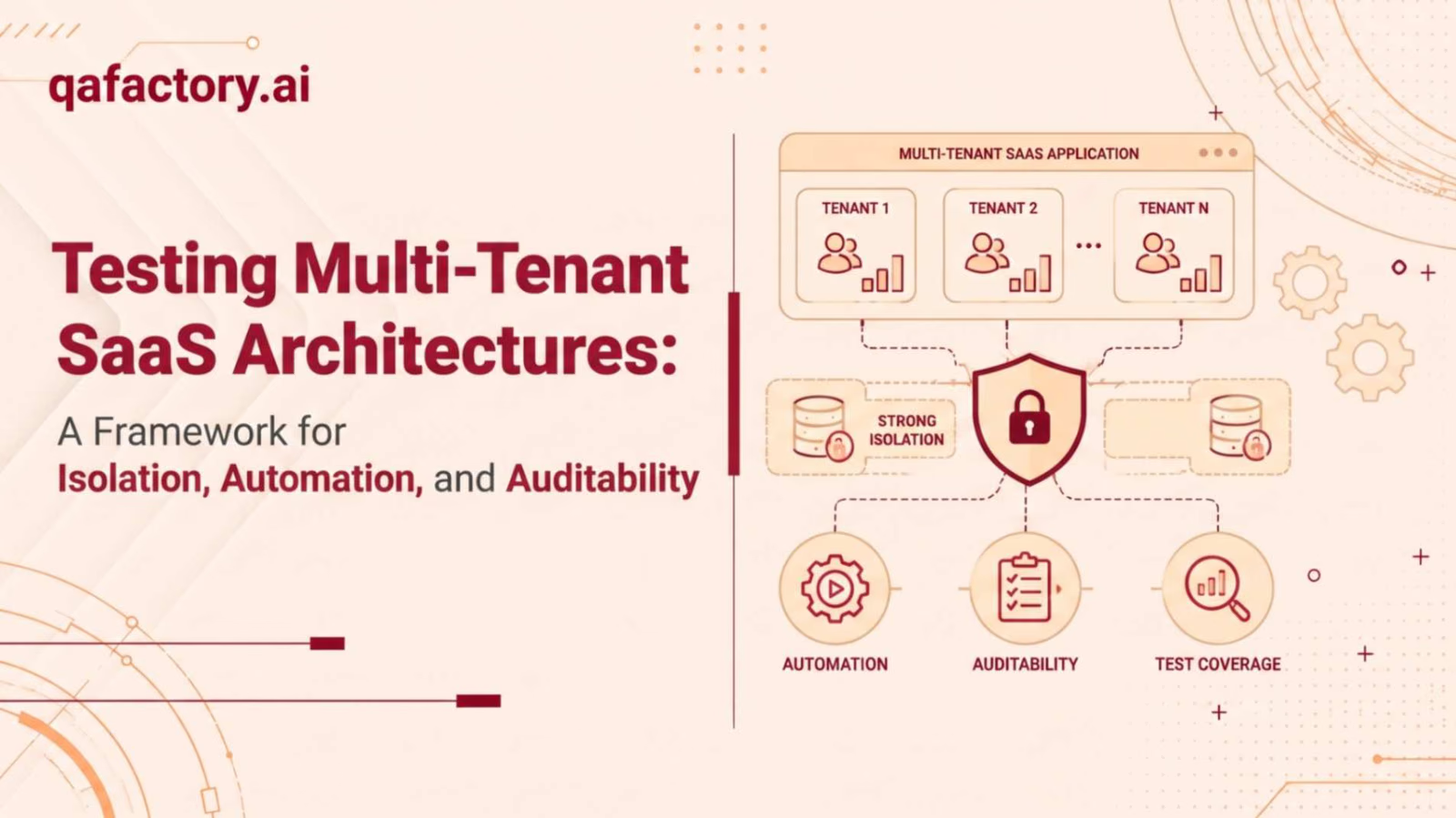
Most SaaS engineering teams discover their multi-tenant testing strategy is broken in production — not in CI. A tenant’s data bleeds into another tenant’s dashboard. A background job processes the wrong tenant_id. A Redis key collision serves cached pricing data across accounts. These are not edge cases; they are the predictable, structural failure modes of any system that shares compute, storage, or cache across tenant boundaries without a deliberate testing architecture built to catch them.
This article is written for engineers who already know how to write tests. It is not an introduction to Playwright or Cypress. It is a technical reference for the specific problem of validating tenant isolation — architecturally, at the database layer, in background workers, and in end-to-end flows — before an auditor, a customer, or an incident does it for you.
What is multi-tenant SaaS testing?
Multi-tenant SaaS testing is the practice of validating that tenant data, sessions, caches, and background jobs remain cryptographically and logically isolated under concurrent load. It requires ephemeral per-tenant provisioning, cross-tenant negative-path assertions, and database-level enforcement checks (e.g., PostgreSQL Row-Level Security) — not just functional UI coverage.
Why single-tenant E2E suites fail
A single-tenant E2E suite validates one thing: does the application behave correctly for one user, in isolation, with no concurrent tenant activity. That assumption is false in every production multi-tenant deployment, and it is exactly the assumption baked into most Cypress and Playwright suites teams inherit from single-tenant origins.
Multi-tenant testing adds a second, orthogonal axis to every test: does this behavior hold when Tenant B is doing something concurrently, adjacent, or maliciously adversarial to Tenant A? Single-tenant suites miss these defects for three structural reasons:
- No concurrent tenant context exists in the test run. A suite that spins up one seeded account per run can never exercise a connection pool under mixed-tenant load, because there is no second tenant contending for the same pool.
- Assertions check “does the right data appear,” not “does the wrong data ever appear.” Positive-path assertions don’t detect leakage; only negative-path assertions across a second tenant’s session do.
- Test data teardown is sequential, not concurrent. Race conditions in row-level security policies, cache invalidation, and queue consumers only surface under overlapping create/read/delete cycles from multiple tenants hitting shared infrastructure simultaneously.
The practical implication: your test architecture needs at least two live, isolated tenant contexts per test run, with assertions written specifically to prove non-access, not just correct access.
The four hidden failure modes in multi-tenant test automation
These four failure modes account for the overwhelming majority of production multi-tenant incidents in SaaS platforms handling 50+ enterprise tenants. Each requires a distinct testing pattern — generic E2E coverage will not surface them.
- 1 Cross-tenant data contaminationRoot cause: missing or misconfigured WHERE tenant_id = ? clauses, ORM scoping bugs, or absent Row-Level Security policies that only fail under specific query paths (joins, raw SQL, admin tooling, reporting exports). It hides because it only manifests when two tenants’ data coexists in the same table and a query path bypasses the application-layer filter — which single-tenant seeded databases can never expose. Test pattern: seed two tenants with structurally identical data and assert that Tenant A’s session returns zero rows belonging to Tenant B across every list, search, export, and reporting endpoint — not just the primary CRUD paths.
- 2 RBAC authorization loops across tenant boundariesRoot cause: RBAC systems that check permission scope (can:edit:invoice) without also validating tenant scope (invoice.tenant_id === session.tenant_id). A user with a valid role in Tenant A can then act on Tenant B’s resources if they can guess or enumerate resource IDs. It hides because RBAC unit tests typically validate role-permission mappings in isolation from tenant context, so the tenant-boundary check is never exercised. Test pattern: for every authenticated mutation endpoint, run a matrix test — (Tenant A user, Tenant A resource) allows; (Tenant A user, Tenant B resource, same role) must reject with 403/404, never 200.
- 3 Shared Redis/cache key collisionsRoot cause: cache keys built from non-tenant-scoped identifiers — cache:user:42:profile instead of cache:tenant:{tenant_id}:user:42:profile. When two tenants share a numerically colliding internal ID (common with auto-increment PKs across separate schemas), one tenant’s cached response is served to another. It hides because cache hit/miss behavior is rarely asserted in E2E tests at all, and single-tenant runs never generate a colliding key. Test pattern: provision two tenants engineered to produce identical internal IDs, trigger a cache-populating read for Tenant A, then immediately assert Tenant B’s equivalent read does not return Tenant A’s cached payload.
- 4 Background worker / queue context slipsRoot cause: async job payloads that lose or fail to re-validate tenant_id context between enqueue and execution — particularly with shared worker pools, generic retry logic, or payloads that reference resource IDs without tenant scoping metadata. It hides because most E2E suites test the synchronous request/response cycle and either mock or ignore the async worker entirely, so the actual job execution — where the bug lives — is never exercised end-to-end. Test pattern: trigger jobs for two tenants concurrently (simultaneous CSV export or email digest generation), poll job completion, and assert each tenant’s output artifact contains only that tenant’s data.
Architectural isolation strategies: a technical comparison
The isolation strategy your team chose at the infrastructure level directly determines your testing burden. Weaker isolation (shared schema) pushes correctness enforcement into application code and tests; stronger isolation (DB-per-tenant) pushes cost and operational complexity up but reduces the surface area tests must cover.
| Strategy | Isolation strength | DB-level enforcement | Test complexity | Blast radius on failure | Typical scale fit |
|---|---|---|---|---|---|
| Shared DB, shared schema (tenant_id column) | Weakest — relies entirely on application/query-layer discipline | Requires PostgreSQL RLS policies as a mandatory safety net; without RLS, isolation is a code convention, not a guarantee | Highest — every query path, ORM scope, and raw SQL statement must be tested for tenant leakage | Catastrophic — a single missing WHERE clause can expose all tenants | High tenant count (1,000+), low per-tenant customization |
| Shared DB, schema-per-tenant (Postgres schemas) | Moderate — physical namespace separation within one database instance | Native schema search_path isolation; still requires connection-level tenant context switching to be verified | Moderate — must test search_path assignment logic and connection pool tenant-switching correctness | Contained to misconfigured schema routing, but pool poisoning can cross schemas | Mid-scale (50–1,000 tenants), moderate compliance requirements |
| DB-per-tenant | Strongest — full physical and credential-level separation | Enforced at the infrastructure layer; no shared query surface exists between tenants by construction | Lowest per-tenant, but highest at fleet scale — provisioning, migration, and teardown automation becomes the primary test target | Isolated to the single tenant’s database; cannot cross-contaminate by design | Enterprise/regulated tenants, SOC 2 / HIPAA requirements, <500 tenants |
| Hybrid (shared pool for SMB, dedicated DB for enterprise tier) | Variable by tier | Combination of RLS (shared tier) + physical isolation (enterprise tier) | Highest overall — requires maintaining two full isolation test suites in parallel | Depends on tier; enterprise tier isolated, shared tier inherits shared-schema risk | Most real-world SaaS platforms with tiered pricing |
Key implementation note: if you’re on shared DB/shared schema, PostgreSQL RLS is not optional — it’s the only mechanism that converts tenant isolation from “something we tested” into “something the database enforces regardless of application bugs.” Your test suite should explicitly assert that RLS policies reject cross-tenant queries even when the application-layer filter is deliberately bypassed (e.g., via a raw SQL test harness), because that’s the failure mode RLS exists to catch.
Writing resilient multi-tenant E2E tests (Playwright implementation)
The core pattern below solves three problems simultaneously: ephemeral tenant provisioning (no shared fixture state between test runs), JWT injection (bypassing UI login for speed and stability), and teardown safety (guaranteed cleanup even on test failure, preventing tenant data from polluting subsequent runs).
// Ephemeral multi-tenant provisioning fixture for Playwright.
// Provisions two isolated tenants per test, injects signed JWTs,
// and guarantees teardown via try/finally regardless of test outcome.

import { test as base, APIRequestContext, request } from '@playwright/test';
import jwt from 'jsonwebtoken';
import { randomUUID } from 'crypto';

interface TenantContext {
  tenantId: string;
  tenantSlug: string;
  userId: string;
  jwt: string;
  apiContext: APIRequestContext;
}

interface MultiTenantFixtures {
  tenantA: TenantContext;
  tenantB: TenantContext;
}

const PROVISIONING_API =
  process.env.TENANT_PROVISIONING_URL ?? 'http://localhost:4000/internal/tenants';
const JWT_SIGNING_SECRET = process.env.TEST_JWT_SECRET as string;

async function provisionTenant(label: string) {
  const ctx = await request.newContext();
  const tenantSlug = `e2e-${label}-${randomUUID().slice(0, 8)}`;

  const res = await ctx.post(PROVISIONING_API, {
    data: {
      slug: tenantSlug,
      plan: 'test-tier',
      seedData: true, // identical record structure across tenants, for symmetry
    },
  });

  if (!res.ok()) {
    throw new Error(
      `Tenant provisioning failed for ${tenantSlug}: ${res.status()} ${await res.text()}`
    );
  }

  const body = await res.json();
  await ctx.dispose();

  return { tenantId: body.tenantId, tenantSlug: body.tenantSlug, userId: body.adminUserId };
}

function signTenantJwt(tenantId: string, userId: string, role = 'admin'): string {
  return jwt.sign(
    { sub: userId, tenant_id: tenantId, role, iss: 'e2e-test-harness' },
    JWT_SIGNING_SECRET,
    { algorithm: 'HS256', expiresIn: '15m' }
  );
}

async function teardownTenant(tenantId: string): Promise<void> {
  const ctx = await request.newContext();
  try {
    const res = await ctx.delete(`${PROVISIONING_API}/${tenantId}`, {
      data: { hardDelete: true, cascadeAllResources: true },
    });
    if (!res.ok()) {
      // Log, don't throw — teardown failures must not mask the original test failure
      console.error(`[teardown] Failed to delete tenant ${tenantId}: ${res.status()}`);
    }
  } finally {
    await ctx.dispose();
  }
}

function tenantFixture(label: string) {
  return async ({}, use) => {
    const { tenantId, tenantSlug, userId } = await provisionTenant(label);
    const token = signTenantJwt(tenantId, userId);
    const apiContext = await request.newContext({
      baseURL: process.env.APP_BASE_URL,
      extraHTTPHeaders: { Authorization: `Bearer ${token}` },
    });

    try {
      await use({ tenantId, tenantSlug, userId, jwt: token, apiContext });
    } finally {
      await apiContext.dispose();
      await teardownTenant(tenantId); // guaranteed even on assertion failure
    }
  };
}

export const test = base.extend<MultiTenantFixtures>({
  tenantA: tenantFixture('a'),
  tenantB: tenantFixture('b'),
});

export { expect } from '@playwright/test';
The cross-tenant negative-path test that this fixture unlocks — the actual defect-catching assertion — looks like this:
import { test, expect } from './tenant-fixture';

test.describe('Cross-tenant data isolation', () => {
  test('Tenant A cannot read Tenant B invoice via direct resource ID', async ({
    tenantA,
    tenantB,
  }) => {
    // Create a resource under Tenant B
    const createRes = await tenantB.apiContext.post('/api/invoices', {
      data: { amount: 4200, currency: 'USD', description: 'E2E isolation probe' },
    });
    expect(createRes.ok()).toBeTruthy();
    const { id: tenantBInvoiceId } = await createRes.json();

    // Attempt to access it using Tenant A's authenticated session
    const crossTenantRes = await tenantA.apiContext.get(`/api/invoices/${tenantBInvoiceId}`);

    // Must NEVER return 200 — 403 or 404 are both acceptable
    expect(crossTenantRes.status()).not.toBe(200);
    expect([403, 404]).toContain(crossTenantRes.status());
  });

  test('Tenant A list endpoint never includes Tenant B records under load', async ({
    tenantA,
    tenantB,
    page,
  }) => {
    // Seed identical-shaped data concurrently to stress shared connection pools
    await Promise.all([
      tenantA.apiContext.post('/api/invoices', { data: { amount: 100, currency: 'USD' } }),
      tenantB.apiContext.post('/api/invoices', { data: { amount: 100, currency: 'USD' } }),
    ]);

    await page.goto(`/t/${tenantA.tenantSlug}/invoices`);
    await page.evaluate((token) => localStorage.setItem('session_jwt', token), tenantA.jwt);
    await page.reload();

    const rows = page.locator('[data-testid="invoice-row"]');
    const rowCount = await rows.count();

    for (let i = 0; i < rowCount; i++) {
      const tenantAttr = await rows.nth(i).getAttribute('data-tenant-id');
      expect(tenantAttr).toBe(tenantA.tenantId); // fails immediately on any leakage
    }
  });
});
Implementation notes that matter in production suites:
- JWT injection beats UI login for isolation testing, because it removes login-flow flakiness as a variable — letting failures point unambiguously at tenant-scoping bugs rather than auth UI issues.
- try/finally teardown is non-negotiable. A failed assertion must not skip teardown — orphaned test tenants accumulate and eventually cause the pool-poisoning and cache-collision bugs described above, inside your own test infrastructure.
- Seed identical data shapes across tenants. Structural symmetry (same field counts, similar auto-increment ranges) is what surfaces ID-collision-based cache and query bugs; asymmetric seed data hides them.
- Run tenant creation concurrently, not sequentially, in any test targeting connection-pool or worker-queue race conditions — sequential provisioning cannot reproduce a race condition by definition.
Enterprise compliance: proving tenant isolation to auditors
For teams pursuing SOC 2 Type II, HIPAA, or enterprise procurement security reviews, “we tested it” is not sufficient evidence. Auditors and enterprise security teams require reproducible, documented proof that tenant isolation holds — typically evidenced through:
- Automated cross-tenant negative-path suites (like the fixture pattern above) that run in CI on every deployment, with historical pass/fail records as audit evidence.
- RLS policy verification tests that prove database-level enforcement independent of application code — auditors specifically look for defense-in-depth, not single points of failure.
- Documented failure-mode coverage mapping each of the four hidden failure modes (contamination, RBAC loops, cache leakage, worker slips) to a specific, named test.
- Load-concurrency evidence showing isolation holds under simultaneous multi-tenant activity, not just sequential single-tenant runs.
This is precisely where most engineering teams hit a wall — not because they can’t write the tests, but because building and maintaining ephemeral multi-tenant test infrastructure, RLS verification harnesses, and audit-ready documentation is a specialized, ongoing discipline that competes directly with feature velocity.
Conclusion
Multi-tenant SaaS testing is not an extension of your existing E2E suite — it’s a distinct discipline requiring concurrent tenant provisioning, negative-path assertions, database-level enforcement verification, and explicit coverage of background worker and cache-layer failure modes. The architectural isolation strategy you’ve chosen directly sets the floor for how much of this burden your tests must carry versus what your infrastructure enforces by construction.
If your team is scaling toward enterprise customers, a SOC 2 audit, or simply past the tenant count where “we haven’t had an incident yet” stops being a strategy — the isolation test suite is the artifact that will be asked for, by name, in the room.
QAFactory works with SaaS engineering teams on exactly this problem: building production-grade, CI-integrated multi-tenant E2E test architectures — ephemeral provisioning, cross-tenant negative-path coverage, RLS enforcement verification, and background-worker race condition testing — engineered to satisfy both internal reliability requirements and external SOC 2 / enterprise audit evidence requirements.
About this article: this reference was prepared by the QAFactory team for engineers building isolation test coverage for multi-tenant SaaS platforms. Code examples are illustrative patterns intended for adaptation, not drop-in production code, and reflect Playwright practices as of 2026.