Functional Testing Services That Catch What Your Sprint Deadline Won’t
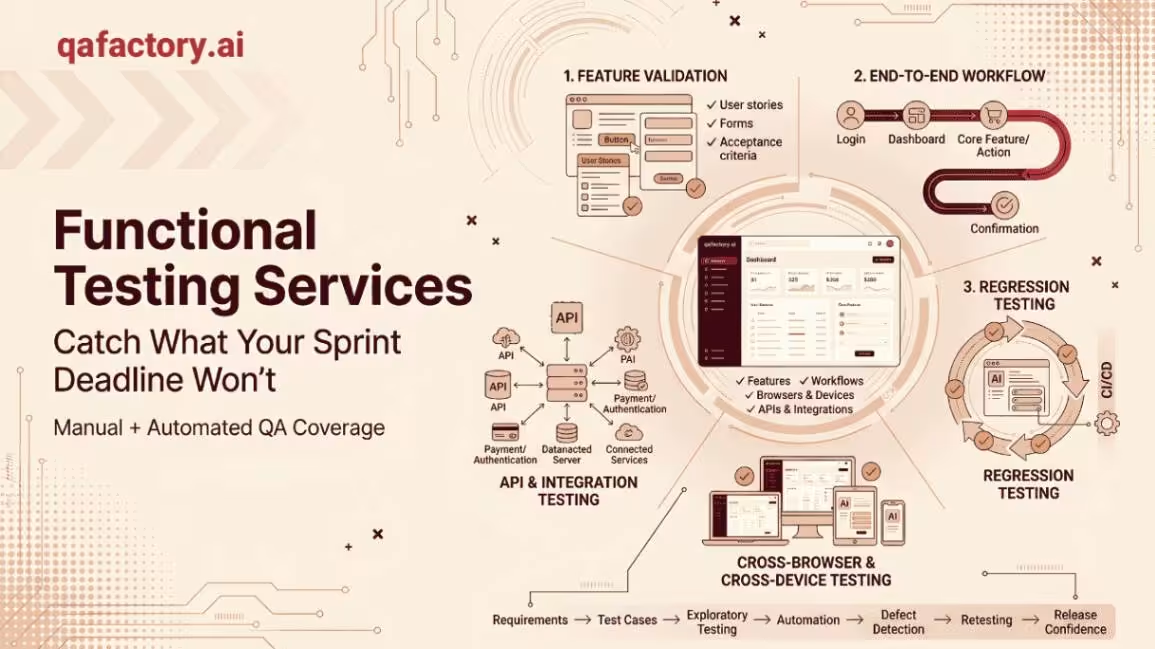
Functional testing services validate that a software application performs its intended functions correctly, from a real user’s perspective, across every feature, workflow, browser, device, and integration point — before defects reach production. Teams typically bring in dedicated functional testing services once release velocity outpaces internal QA capacity, since undetected defects cost significantly more to fix in production than in pre-release testing.
If you’re reading this, you’ve probably already lived through the alternative: a feature ships on Friday, a customer hits an edge case on Saturday, and your on-call engineer spends Sunday untangling a bug that a proper test pass would have caught in twenty minutes. That’s not a QA problem. That’s a functional testing gap, and it’s one of the most common — and most fixable — reasons SaaS teams bleed engineering hours on preventable fires.
Functional testing verifies that your application does what it’s supposed to do, from the user’s perspective, under the conditions your users will actually create. Not synthetic conditions. Not the happy path your team tested three sprints ago. The real thing — messy inputs, unexpected navigation, concurrent sessions, partial form submissions, and every other way real people interact with software that engineers rarely anticipate.
At QAFactory.ai, we build functional testing programs for engineering teams who’ve outgrown “test it before we ship it” as a strategy. Here’s how we do it, and why it matters more than most teams realize until they’ve already paid the cost of skipping it.
What functional testing actually covers
Functional testing isn’t one activity — it’s a discipline made up of several interlocking test types, each validating a different layer of how your application behaves.
Quick fact: functional testing typically covers five core layers — feature-level validation, end-to-end workflow testing, regression testing, cross-browser/device testing, and API/integration testing.
Feature-level validation
Every user story, every acceptance criterion, every button that’s supposed to do exactly one thing. This is the foundation: confirming that individual features work as specified against your requirements documentation, not against assumptions.
End-to-end workflow testing
Individual features passing in isolation means nothing if the workflow connecting them breaks. A checkout flow might have a flawless cart page, a flawless payment page, and a flawless confirmation page — and still fail if the session token expires between steps two and three. We test the full journey, not the parts.
Regression testing
Every new deployment risks breaking something that used to work. Regression suites — whether run manually for high-risk releases or automated for continuous delivery pipelines — exist to catch that silent breakage before your users do. This is where a dedicated functional testing partner earns their keep: regression debt compounds fast when it’s handled ad hoc by developers who are also trying to ship new features.
Cross-browser and cross-device testing
Your app works perfectly in Chrome on your MacBook. Does it work on Safari for a user on an older iPad with a spotty connection? Functional testing at a professional level accounts for the actual device and browser matrix your analytics say your users are on — not the one your dev team happens to use.
API and integration testing
Modern SaaS products are rarely self-contained. They talk to payment processors, auth providers, third-party APIs, and internal microservices. Functional testing has to validate those contracts too — request/response accuracy, error handling, timeout behavior, and data integrity across service boundaries.
Why “we’ll test it ourselves” stops scaling
Most engineering teams start out testing their own code, and for a while, that’s fine. The trouble starts when the codebase grows faster than the team’s capacity to manually verify it. A few patterns we see constantly when we start a QA audit with a new client:
- Developers testing their own code miss the same blind spots repeatedly. You can’t effectively QA a mental model you built yourself — you test what you expect to happen, not what actually might.
- “We’ll add tests later” becomes permanent technical debt. Later rarely comes when the backlog is full of features stakeholders are asking for by name.
- Release cadence and test coverage move in opposite directions. As teams ship faster to stay competitive, the temptation to skip full regression passes grows — right when the risk of skipping them is highest.
- Bug triage eats senior engineering time. Every hour a senior developer spends reproducing a customer-reported bug that a proper test pass would have caught is an hour not spent building.
None of this means your engineers are bad at their jobs. It means functional testing is a specialized discipline with its own methodology, tooling, and mindset — and treating it as a leftover task for whoever has spare cycles is how quality erodes without anyone noticing until churn numbers move.
Our functional testing methodology
We don’t run a generic checklist against your app. Every engagement starts with understanding your architecture, your release cycle, and where your specific risk actually lives.
1. Requirements and risk mapping
We start by reviewing your product requirements, user stories, and — critically — your incident history. Past bugs are the best predictor of where future bugs will hide. This step also defines test coverage priorities so we’re not spending equal effort on a rarely-used admin panel and your core revenue-generating checkout flow.
2. Test case design
We build structured test cases mapped to acceptance criteria, covering positive paths, negative paths, boundary conditions, and edge cases your team hasn’t had time to think through. This documentation itself becomes an asset — a living record of expected behavior your team can reference long after the testing engagement.
3. Manual exploratory testing
Scripted tests catch what you expected to break. Exploratory testing, run by engineers who think like adversarial users, catches what you didn’t expect. This is where experienced human testers still outperform automation — probing UI states, unusual sequences, and interactions that a script wasn’t written to anticipate.
4. Automated regression suites
For workflows that need repeated validation across every release, we build automated test suites — typically using frameworks matched to your stack (Selenium, Playwright, Cypress, or your existing tooling) so regression testing becomes a fast, repeatable gate rather than a multi-day manual effort before every deploy.
5. Defect reporting and retesting
Every defect we log includes reproduction steps, environment details, severity classification, and expected-versus-actual behavior — the kind of report your developers can act on immediately without a follow-up meeting. Once fixes ship, we retest to confirm closure and check for regressions introduced by the fix itself.
6. Reporting and metrics
You get visibility into test coverage percentage, defect density by module, pass/fail trends across releases, and mean time to detection. These aren’t vanity metrics — they’re the numbers that let engineering leadership actually answer “is our quality improving or degrading” with data instead of gut feeling.
What good functional testing actually prevents
It’s worth being concrete about the cost side of this equation. Teams that treat functional testing as optional tend to discover its value retroactively — after a payment bug, after a data-loss incident, after a churn spike that traces back to a broken onboarding flow. Industry benchmarks from bodies like the ISTQB consistently show that the cost of fixing a defect found in production runs many multiples higher than catching it in a pre-release test pass, once you account for engineering hours, customer support load, and reputational damage. A structured functional testing program isn’t overhead — it’s one of the cheapest insurance policies available to a growing SaaS company.
Who this is for
This service fits teams that recognize a specific inflection point: your product has grown complex enough, and your release cadence fast enough, that internal QA capacity — or the lack of it — has become a genuine bottleneck to shipping confidently. That’s typically:
- Series A–C SaaS companies scaling engineering headcount faster than QA headcount
- Enterprise software teams with compliance or reliability requirements that don’t tolerate regressions
- Startups preparing for a major release, funding milestone, or enterprise client onboarding where downtime isn’t an option
- Engineering leaders who’ve inherited a codebase with thin or nonexistent test coverage
If any of that sounds familiar, it’s worth starting with a conversation about where your current coverage actually stands. A 48-hour QA audit is often the fastest way to see exactly where the gaps are before committing to a full testing engagement.
Frequently asked questions
What is the difference between functional testing and non-functional testing?
Functional testing checks whether a system does what it’s supposed to do — features, workflows, and business logic. Non-functional testing checks how well it does it — performance, load capacity, security, and usability. Both matter, but functional testing comes first: there’s no point load-testing a checkout flow that doesn’t process payments correctly.
How long does a functional testing engagement typically take?
It depends on application complexity and existing test coverage, but most engagements start with a scoped assessment (often completed within 48 hours) followed by a testing plan sized to release cadence — anywhere from a single pre-launch test pass to an ongoing regression program tied to every sprint.
Do functional testing services replace an internal QA team?
Not usually. Most SaaS companies use external functional testing services to extend internal capacity — covering overflow during release crunches, providing specialized automation expertise, or handling full QA for teams that don’t have in-house testers yet. It’s rarely all-or-nothing.
What’s included in manual vs. automated functional testing?
Manual testing covers exploratory testing, usability checks, and scenarios that require human judgment. Automated testing covers repeatable regression suites that run on every build. A mature functional testing program uses both — automation for coverage and speed, manual testing for the edge cases scripts don’t catch.
How much does functional testing cost compared to fixing bugs in production?
Exact costs vary by scope, but the pattern holds across the industry: defects caught in pre-release testing cost a fraction of what the same defect costs once it reaches production, once you factor in engineering hours, customer support tickets, and churn risk.
Getting started
Functional testing works best when it’s not a one-time event bolted onto a launch, but a standing part of how your team ships software. We typically start engagements with a scoped assessment of your current application, existing test coverage, and release process, then build a testing plan sized to your actual risk profile — not a generic package that either over-tests low-risk areas or under-tests the ones that matter.
If your team is shipping fast and wants confidence that speed isn’t quietly costing you reliability, that’s exactly the problem functional testing is built to solve.