The engineer’s guide to outsourced QA testing for SaaS in 2026
Shipping features faster is the mandate for every engineering team in 2026. But as SaaS products grow more complex — more integrations, more tenants, more edge cases — testing infrastructure is often the first thing to fall behind. Building and maintaining an internal QA function takes recruiting time, tooling investment, and ongoing management attention that many engineering teams would rather spend on product work.
That tension is why a growing number of SaaS companies are turning to outsourced QA testing: bringing in specialized external teams who integrate directly into existing CI/CD pipelines, rather than trying to build every testing capability in-house from day one.
This guide covers what outsourced QA testing actually involves, when it makes sense, how its cost compares to in-house QA, and how to evaluate a partner — written from an engineering perspective, not a sales one.
What is outsourced QA testing for SaaS?
Outsourced QA testing is the practice of engaging an external team of QA specialists to design, execute, and maintain testing for a SaaS product — typically covering functional, regression, API, and automated testing — while working directly within the engineering team’s existing development and release workflows, including CI/CD pipelines, ticketing systems, and code repositories.
Why SaaS companies outsource QA testing
SaaS companies outsource QA testing primarily to access specialized automation expertise, scale testing capacity around release cycles, and reduce the time engineers spend on manual or maintenance-heavy testing work. Rather than replacing engineering judgment, outsourced QA extends it — giving teams dedicated testing capacity without the fixed cost and ramp-up time of building an internal function from scratch.
Common drivers include:
- Product complexity has outpaced internal testing capacity
- Developers are absorbing test maintenance work instead of building features
- Releases feel increasingly risky or reactive
- Specialized skills — Playwright, Cypress, API testing — aren’t present in-house
- Testing needs fluctuate with release cadence, making a fixed headcount inefficient
In-house QA vs. outsourced QA
Neither model is universally better. The right choice depends on company stage, product complexity, and how central testing is to your competitive advantage.
| Factor | In-house QA | Outsourced QA |
|---|---|---|
| Hiring | Requires a dedicated recruiting and interview process | Access to an already-formed, experienced testing team without running a hiring process |
| Ramp-up | Product context builds naturally as the team embeds full-time | Requires structured onboarding to establish product context before becoming fully effective |
| Specialized expertise | Limited to the skills already on the team | Easier to access niche skills (e.g., specific automation frameworks) without new hires |
| Scalability | Scaling up or down requires hiring or layoffs | Capacity can typically flex around release cycles more easily |
| Tooling | Team selects and owns tooling, building deep familiarity over time | Provider often brings existing tooling and frameworks, reducing setup effort |
| Test automation | Quality depends on in-house automation skill | Often benefits from teams that specialize specifically in automation engineering |
| CI/CD integration | Native, since the team already owns the pipeline | Requires deliberate integration work, but is standard practice for experienced partners |
| Management overhead | Direct day-to-day management, embedded in team rituals | Requires clear communication processes and defined ownership boundaries |
| Product context | Deep and continuous, but takes time to build | Improves over time; strongest in long-term rather than one-off engagements |
| Cost model | Fixed cost (salaries, benefits, tooling) regardless of testing volume | Variable cost that can align more closely with actual testing volume |
| Best fit | Products where testing is a core differentiator or deep, continuous context is critical | Teams needing to scale testing capacity or specialized skill without long-term fixed headcount |
The true cost and ROI of outsourced QA testing
Whether outsourced QA testing is cheaper than in-house QA depends on total cost of ownership, not hourly rates alone. In-house QA carries costs like recruiting, training, tooling, and management overhead in addition to salaries, while outsourced QA typically bundles many of these into service fees. The right comparison weighs full cost against the value delivered — not sticker price.
Total in-house QA cost can include:
- Salaries and benefits
- Recruitment
- Onboarding
- Management time
- Training and skill development
- Devices and browser/device labs
- Infrastructure
- Testing tool licenses
- Test automation maintenance
- Opportunity cost of engineering time spent on testing instead of features
Outsourced QA cost can include:
- Service fees
- Setup and integration effort
- Project management
- Access to specialized testing skill without a separate hiring process
A useful way to frame it: ROI = value created (faster releases, earlier defect detection, fewer production incidents, developer time freed for feature work) / total cost of the testing approach.
Illustrative example (hypothetical — not QAFactory client data): a SaaS company might compare the fully-loaded annual cost of hiring two in-house QA engineers — salary, benefits, tooling, and ramp-up time — against an outsourced engagement scoped to equivalent coverage. If the outsourced engagement reaches productivity faster and doesn’t carry the same fixed overhead during slower release periods, the effective cost per release cycle could be lower. This depends entirely on scope, product complexity, and how the engagement is structured, and is provided only to illustrate the framework — not as a real-world benchmark.
What an outsourced SaaS QA team actually does
- Product and context onboarding — understanding the product, roadmap, and existing test coverage.
- Risk assessment — identifying which flows carry the most business or technical risk.
- Test strategy — defining what should be automated vs. tested manually, and coverage priorities.
- Test case design — writing test cases aligned to real user and system behavior.
- Automation planning — choosing tooling and framework approach (e.g., Playwright, Cypress).
- API and backend testing — validating data integrity, contracts, and performance at the API layer.
- UI testing — functional and cross-browser validation of user-facing flows.
- Regression testing — confirming existing functionality still works after changes.
- CI/CD integration — wiring tests into pull request checks and release pipelines.
- Defect reporting — clear, reproducible bug reports tied to acceptance criteria.
- Release validation — smoke and regression checks before and after deployment.
- Test maintenance — updating tests as the product evolves.
- Reporting and quality metrics — visibility into coverage, pass rates, and trends over time.
How outsourced QA integrates with CI/CD
An outsourced QA team integrates with CI/CD by connecting automated tests into existing pipelines — running checks on pull requests, executing regression and smoke suites at defined stages, and gating releases based on test results — using the same tools the engineering team already relies on, such as GitHub Actions, GitLab CI, or Jenkins.
A typical flow looks like this:
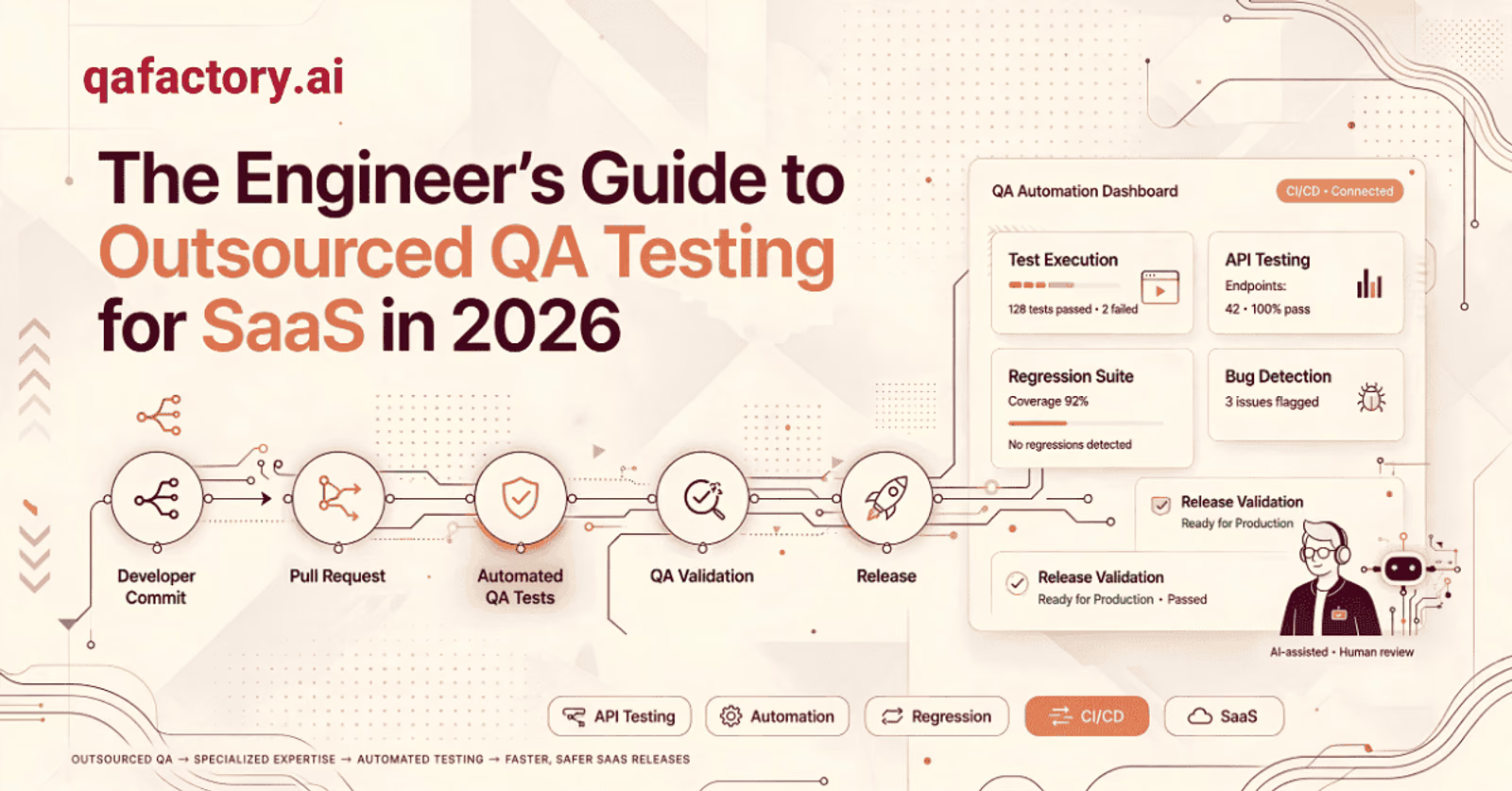
Developer commit → Pull request → Automated tests (PR checks) → QA validation → Failure reporting → Fix → Re-test → Staging → Release validation (smoke/regression) → Production.
Key concepts involved:
- PR checks that block merges on failing tests
- Regression suites run at defined pipeline stages
- Smoke tests for fast, high-level release confidence
- Nightly test runs for broader, slower coverage
- Release gates that require passing tests before deployment
- Test reporting dashboards for visibility into pass rates and trends
- Failure triage processes to distinguish real bugs from flaky results
What types of SaaS testing can be outsourced?
Not every SaaS product needs every type of testing — scope should match risk and complexity. Common categories include:
- Functional testing
- Regression testing
- Test automation (build and ongoing maintenance)
- API testing
- Integration testing (third-party services, webhooks)
- Cross-browser testing
- Mobile testing, where relevant to the product
- Performance testing (load and response time under usage)
- Security-focused testing (access control, authentication flows)
- Release testing (pre- and post-deployment validation)
How to reduce flaky tests in SaaS CI/CD
Flaky tests — tests that fail intermittently without a real underlying bug — are one of the most common reasons engineering teams lose trust in automated testing. Reducing them typically involves:
- Robust, stable locators instead of brittle selectors
- Strict test isolation, including clean, dedicated test data per run
- Deterministic waiting strategies instead of fixed sleeps
- Separating environment or infrastructure flakiness from genuine test failures
- Regular pruning and review of the automation suite, not just adding new tests
Teams that work across many CI/CD environments often bring practiced approaches to this problem, but flaky test reduction is an ongoing discipline, not a one-time fix.
Testing multi-tenant SaaS applications
Multi-tenancy is one of the most distinct challenges in SaaS QA, and generic software testing approaches don’t fully cover it. Key areas to test include:
- Tenant isolation — confirming one tenant’s actions can’t affect another tenant’s data or experience.
- Role isolation — validating that permissions behave correctly across different user roles within a tenant.
- Cross-tenant data leakage — specifically testing for cases where data could unintentionally cross tenant boundaries.
- Test data separation — using distinct, controlled test data per tenant scenario to avoid false positives or negatives.
- Subscription-level behavior — verifying that plan tiers, feature flags, and entitlements behave as expected across upgrade and downgrade paths.
AI-assisted QA in 2026
AI-assisted QA in 2026 typically supports tasks like test case generation, test data generation, failure analysis, and locator maintenance — reducing repetitive manual work. It does not replace QA engineers: AI-generated suggestions and changes still require human validation before being trusted in a release pipeline.
Realistic, practical uses include:
- Test case generation from requirements or user flows
- Test data generation for edge cases
- Test failure analysis and log analysis to speed up triage
- Locator and maintenance assistance when UI elements change
- Defect summarization for faster reporting
- Regression prioritization based on change risk
AI-assisted maintenance can meaningfully reduce the manual effort required when UI elements change, but automated changes should still pass validation before release. AI improves QA productivity — it doesn’t remove the need for engineering judgment.
Risks of outsourced QA testing — and how to mitigate them
Outsourcing QA is not risk-free, and a credible partner should be able to discuss these openly rather than avoid them.
| Risk | Mitigation strategy |
|---|---|
| Communication gaps | Establish clear communication channels, shared documentation, and regular sync points |
| Product context loss | Invest in structured onboarding and treat context-building as ongoing, not one-time |
| Access and security concerns | Define clear access controls, scoped permissions, and a security review process before granting environment access |
| Inconsistent test ownership | Establish clear ownership boundaries for who maintains which tests |
| Timezone differences | Plan handoff windows and asynchronous reporting to avoid bottlenecks |
| Vendor dependency | Maintain internal visibility into test suites rather than relying on a full black box |
| Poor documentation | Require documented test strategy, coverage, and defect reports as a baseline expectation |
| Flaky automation | Require a stated, concrete approach to flaky test management — not just automation volume |
| Unclear acceptance criteria | Align on acceptance criteria and definition of done before test design begins |
How to choose an outsourced QA partner
Choosing an outsourced QA provider comes down to evaluating SaaS-specific experience, automation capability, API testing skill, CI/CD integration experience, and how clearly they communicate test ownership, reporting, and defect management — not just cost per hour.
Checklist:
- SaaS experience (multi-tenancy, subscription models, permissions)
- Automation expertise and maintainability of their approach
- Playwright and/or Cypress capability specifically
- API testing capability
- CI/CD integration experience
- Security and access practices
- Clear reporting and quality metrics
- Structured defect management process
- Clear test ownership model
- Responsive, structured communication
- Ability to scale with release cycles
- Demonstrable technical capability, not just claims
Red flags:
- Only offers manual testing with no automation roadmap
- No experience integrating with CI/CD pipelines
- Vague or inconsistent reporting
- No clear model for test ownership
- Promises unrealistic outcomes, such as guaranteed zero bugs or full automation coverage
- No defined security or access process
- Can’t clearly explain how they manage flaky tests
When should a SaaS company outsource QA?
A SaaS company should consider outsourcing QA when developers are regularly spending meaningful sprint capacity on test maintenance instead of feature work, when releases feel risky or reactive, when specialized skills like automation frameworks or API testing are missing internally, or when testing needs fluctuate more than a fixed in-house team can efficiently support.
Signals it may be time:
- Test maintenance is consistently competing with feature development time
- Release days are stressful, reactive, or prone to hotfixes
- The team lacks depth in specific tools like Playwright or Cypress
- Testing needs spike around releases but don’t justify permanent headcount
- Product complexity — multi-tenancy, integrations — has outpaced current test coverage
How QAFactory approaches outsourced QA testing
At QAFactory, we work as an extension of the engineering team rather than as a disconnected testing vendor. Our approach centers on:
- API and backend validation — testing data integrity, contracts, and performance at the API layer, often before UI work is complete.
- Multi-tenant testing — designing test data and scenarios specifically around tenant and role isolation.
- CI/CD-integrated automation — building and maintaining Playwright and Cypress suites that run as part of existing pipelines, not as a separate process.
- AI-assisted test maintenance — using AI tooling to reduce the manual effort of keeping automation current as the product changes, with human validation before changes are trusted in a pipeline.
Conclusion
Outsourced QA testing isn’t a replacement for engineering judgment — it’s a way to extend testing capacity, access specialized automation skill, and reduce the amount of sprint time spent on test maintenance rather than product work. It works best when scoped clearly, integrated directly into existing CI/CD workflows, and evaluated on total cost of ownership rather than hourly rate alone.
If test maintenance is consuming more of your team’s time than it should, or your release process feels more reactive than confident, it may be worth evaluating what a dedicated outsourced QA partner could take off your plate.
Ready to see where outsourced QA could fit into your release process? Book a QA audit with QAFactory to review your current testing coverage and identify where dedicated QA support could reduce risk and free up engineering time.
Frequently asked questions
What is outsourced QA testing?
Outsourced QA testing is when a SaaS company engages an external team of QA specialists to design, execute, and maintain testing — functional, regression, API, and automated — while integrating with the company’s existing development and CI/CD workflows.
Why do SaaS companies outsource QA?
Most commonly to access specialized automation expertise, scale testing capacity around release cycles, and free up developer time currently spent on manual or maintenance-heavy testing work.
Is outsourced QA testing cheaper than hiring an internal team?
It depends on total cost of ownership. In-house QA includes recruiting, training, tooling, and management overhead beyond salary; outsourced QA typically bundles these into service fees. Whether it’s cheaper depends on scope and how the engagement is structured, not hourly rate alone.
What types of QA testing can be outsourced?
Common categories include functional, regression, API, integration, cross-browser, mobile (where relevant), performance, security-focused, and release testing — though not every SaaS product needs every type.
Can outsourced QA teams work with CI/CD pipelines?
Yes. Experienced outsourced QA partners integrate directly into tools like GitHub Actions, GitLab CI, or Jenkins, running automated checks on pull requests and gating releases based on test results.
Can an outsourced QA team build Playwright automation?
Yes — Playwright, along with Cypress, is a common automation framework outsourced QA teams use to build and maintain test suites integrated into CI/CD pipelines.
How does outsourced QA handle SaaS multi-tenancy?
By specifically testing for tenant isolation, role isolation, cross-tenant data leakage, and subscription-level behavior — using dedicated, isolated test data for each scenario.
When should a SaaS startup outsource QA?
When test maintenance is consistently competing with feature development time, releases feel risky or reactive, or the team lacks depth in specific automation tooling — and permanent QA headcount isn’t yet justified.
What should I look for in an outsourced QA provider?
SaaS-specific experience, automation expertise in Playwright or Cypress, API testing capability, CI/CD integration experience, clear reporting, and a defined model for test ownership and communication.
Is outsourced QA suitable for early-stage SaaS companies?
It can be, particularly when the team needs testing capacity or automation expertise without the fixed cost and ramp-up time of hiring a full in-house QA function — though scope should still match the company’s actual risk and complexity.
About this article: this guide was prepared by the QAFactory team as a practical, engineering-first reference for evaluating outsourced QA testing options. It reflects general SaaS QA outsourcing and CI/CD integration practices as of 2026.